Guide
How to Keep Squirrels Off a Bird Feeder: 7 Methods Ranked
Move feeders 10 ft from jump points, add a baffle 4-5 ft up, and use a squirrel-resistant feeder. 7 sourced methods, ranked by effort and payoff.
ResearchedBy Feeder Field Editorial Team
Last updated · Published
Disclosure: We may earn a commission when you buy through links on this page. Read our affiliate disclosure.
Short answer: the three steps that do most of the work
- Move the feeder at least 10 feet from anything a squirrel can jump from: trees, fences, deck rails, roofs (Project FeederWatch).
- Mount it on a pole with a baffle whose top sits 4 to 5 feet off the ground (Wild Birds Unlimited).
- If squirrels still get on, switch to a weight-activated or caged feeder. See our best squirrel-proof bird feeders.
If you want to know how to keep squirrels off a bird feeder, start with where the feeder hangs. A $130 squirrel-proof feeder hanging from a maple branch is within easy reach. A cheaper feeder on a baffled pole out in the open is much harder to get to. This guide ranks seven methods by effort and payoff, and says plainly which one is unproven, using guidance from Cornell Lab’s Project FeederWatch, university extension services and manufacturers.
How this page was made: This is a researched guide. We haven’t run our own before-and-after test, so there are no raid logs or photos of our own here. Every distance and size below comes from the source we link. See how we test.
Why squirrels win
Squirrels are built for the problem a bird feeder presents. They:
- Jump. Project FeederWatch says squirrels can jump to feeders placed less than 10 feet from a tree or building.
- Climb. Wood posts and tree trunks are easy. Wild Birds Unlimited notes that most basic shepherd’s hooks are not tall enough to squirrel-proof a feeder.
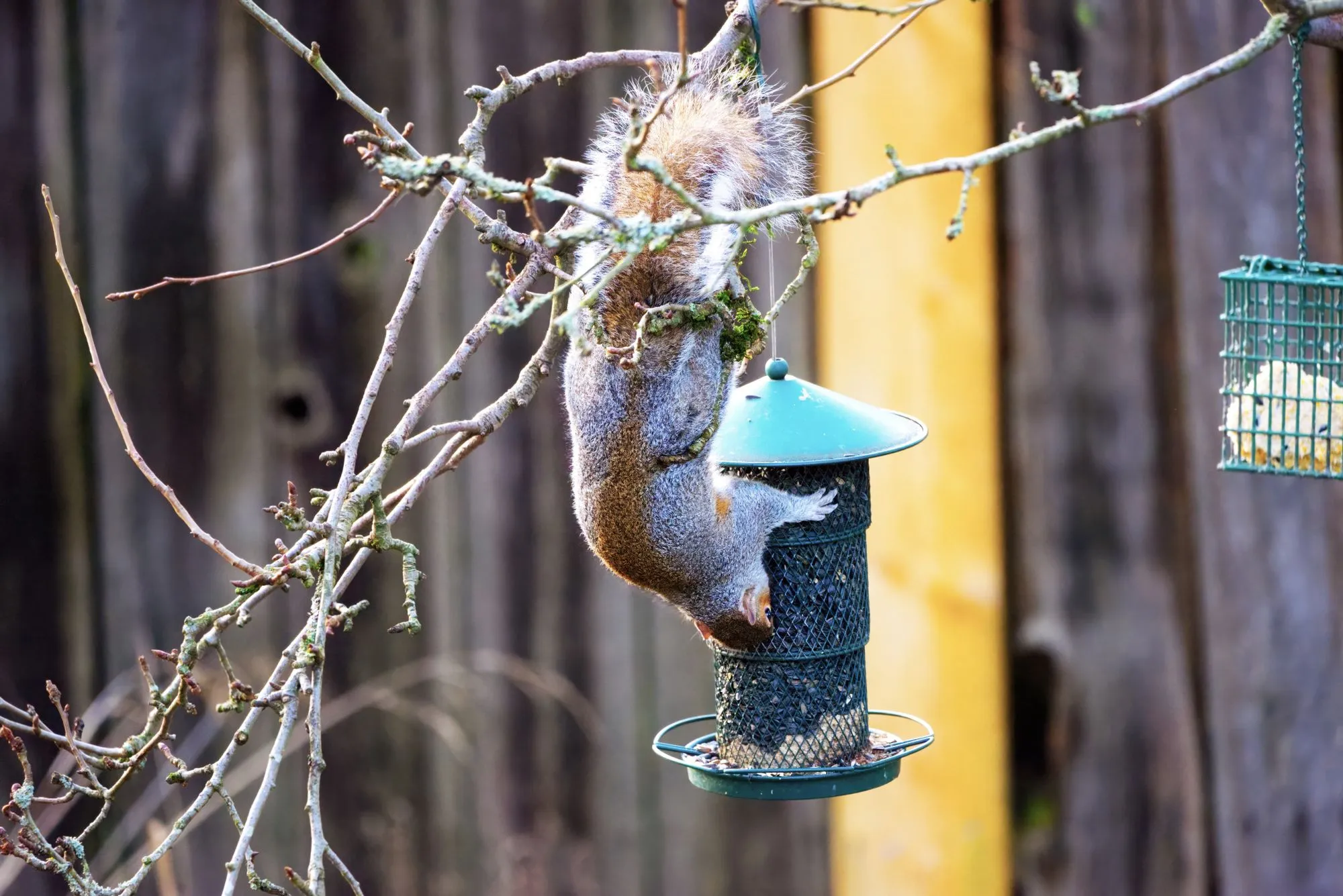
- Hang upside down from hooks and feeder roofs to reach ports.
- Keep trying. UNH Extension notes that hungry squirrels can be very determined and may eventually find a way to the seed (UNH Extension).
Which squirrel you have matters too. Eastern gray and fox squirrels are heavy enough to trip weight-activated feeders and too big for 1.5-inch cage openings. Red squirrels and chipmunks are much smaller. Brome, for example, says its Squirrel Buster feeders won’t deter juvenile red, Douglas or flying squirrels, or chipmunks (Brome).
And if seed vanishes overnight, the culprit may not be a squirrel at all. Raccoons, opossums and, in some regions, bears raid feeders after dark. Brome recommends bringing feeders in at night to prevent this (Brome).
The methods, ranked by effort vs. payoff
| # | Method | Effort | Cost | How much it helps |
|---|---|---|---|---|
| 1 | Move the feeder out of the jump zone | Low | $0 | High (it’s the foundation) |
| 2 | Add the right baffle (and a proper pole) | Medium | ~$70 baffle; pole systems cost more | High |
| 3 | Switch to a squirrel-resistant feeder | Low | ~$60–$230 | High against gray/fox squirrels |
| 4 | Change the seed | Low | Similar to now | Low to medium, varies by area |
| 5 | Offer a diversion feeder | Low | Ongoing food cost | Unproven |
| 6 | Keep the ground clean | Low, ongoing | $0 to a seed tray | Medium (removes the reward) |
| 7 | Bring feeders in at night | Low, daily | $0 | High for raccoons and bears |
The effort and payoff ratings are our editorial judgment based on the sources in each section, not measured results.
Method 1: Move the feeder out of the jump zone
This is the free step, and the other methods depend on it.
The jump zone, by the numbers:
| Measurement | Rule | Source |
|---|---|---|
| Sideways distance from trees, fences, roofs, deck rails | At least 10 ft | Project FeederWatch; UNH Extension |
| Height of the top of a pole baffle | 4–5 ft above ground | Wild Birds Unlimited |
| Tilting baffle above the feeder, for jumps from above | At least 18 in. across | Project FeederWatch |
How to do it:
- Walk the yard with a tape measure and mark every launch point: trunks, overhanging branches, fence tops, deck rails, eaves, patio furniture.
- Find a spot at least 10 feet from all of them. Branches overhead count too, since a squirrel can drop onto a feeder from above.
- Balance this with bird safety. Birds like cover nearby, and distance from windows affects window strikes. Our guide to where to put a bird feeder shows how to fit all three rules in one yard.
If no spot in your yard is 10 feet from everything, go to Method 2 and use both a pole baffle and an overhead baffle.
Method 2: Add the right baffle
Project FeederWatch says baffles are usually the best way to keep squirrels away from seed. A baffle only works if the squirrel can’t get around it by jumping, so Method 1 still applies.
Dome vs cone/stovepipe baffles
- Pole baffles (stovepipe, torpedo or cone) go on the pole under the feeder and stop climbers. A stovepipe is a tall cylinder a squirrel can’t grip or reach around. For example, the Squirrel Stopper Metal Standard Baffle is 27 inches tall, tapers from 7 inches at the top to 4⅛ inches at the bottom, fits round poles ½ to 2 inches in diameter, and floats and rocks so squirrels can’t grab on. Duncraft lists it at $69.95 (Duncraft).
- Dome baffles hang above a feeder and stop squirrels dropping or climbing down from above. UNH Extension says tilting or large dome baffles are best for feeders hung from tree branches. FeederWatch suggests a tilting baffle at least 18 inches in diameter.
A pole baffle to consider: Squirrel Stopper Metal Standard Baffle (opens in a new tab). It was not available to order at Duncraft when we checked on October 8, 2026, so check other sellers.
Pole systems
A pole system bundles the pole, baffle and hanging arms, so you don’t have to match a baffle to a pole diameter. The Squirrel Stopper Sequoia, for example, stands 7 ft 6 in. above ground, has four hanging stations and a baffle that moves up, down and side to side. Its maker recommends placing it at least 10 feet from structures (TreeHelp listing). Prices and stock vary widely between retailers, so check before you buy.
One to consider: Squirrel Stopper Sequoia pole system (opens in a new tab). It was available to order at Duncraft for $199.95 when we checked on October 8, 2026.
Common baffle mistakes:
- Baffle too low, so squirrels jump over it from the ground.
- Pole too close to a fence or shrub, so squirrels jump past the baffle.
- Hanging arms that reach toward a tree and bring the feeder back into the jump zone.
Method 3: Switch to a squirrel-proof feeder
Once squirrels can’t easily reach the feeder, a squirrel-resistant feeder deals with the ones that still do. The main types:
- Weight-activated: a squirrel’s weight closes the seed ports. Brome’s Squirrel Buster models use an adjustable spring, so you can set it to let cardinals feed (Brome).
- Motorized: a squirrel’s weight starts a motor that spins the perch, as on the Droll Yankees Yankee Flipper (Amazon).
- Caged: a wire cage with 1½-inch openings lets smaller birds in and keeps squirrels out (Wild Birds Unlimited). Red squirrels and chipmunks may still fit.
Which type beats which squirrel tactic, and our top picks for each, are in best squirrel-proof bird feeders.
Method 4: Change the seed
Seed won’t fix a bad location, but it can make your feeder less rewarding.
- Safflower. Cornell’s All About Birds says that, according to some sources, House Sparrows, European Starlings and squirrels don’t like it, but in some areas they seem to have developed a taste for it (All About Birds).
- Nyjer (thistle). Eaten mainly by small finches, such as goldfinches, Pine Siskins and redpolls (Audubon). It serves a narrower set of birds.
- Avoid cracked corn if squirrels are your problem. Audubon notes that it attracts them.
- Hot-pepper (capsaicin) seed. It’s widely sold, but the evidence is thin. Project FeederWatch says it is unaware of research on the effect of high doses of capsaicin on birds. In unpublished Maryville University research reported by Audubon, Northern Cardinals, Carolina Chickadees and House Finches ate less seed at around 500,000 Scoville units and refused it at about 1 million, and the researcher said hungry squirrels will eat hot seed anyway (Audubon). Don’t make your own by dusting seed with cayenne. Nobody has shown what dose is safe.
The trade-off with any seed swap is that it also changes which birds come. Our bird seed guide and All About Birds’ guide to types of bird seed show which birds eat what.
Method 5: A diversion feeder
Some people put out corn or peanuts for squirrels at the far side of the yard, on the idea that a squirrel with an easy meal won’t work for a hard one. We found no study showing how well this works, so treat it as an experiment, not a fix. Three cautions:
- Put it well away from the bird feeders, ideally near the squirrels’ trees, so they don’t cross the yard past your bird feeder.
- More food can bring more squirrels, and other wildlife, over time.
- In bear country, a squirrel station is still bear bait. Follow your state’s guidance (see Method 7).
Method 6: Keep the ground clean
Spilled seed under a feeder keeps squirrels, chipmunks and rodents coming back and checking the feeder above. To cut it down:
- Skip cheap mixes. Audubon calls mixes padded with filler, wheat and red milo “bad” seed that most birds reject (Audubon), and rejected seed ends up on the ground.
- Consider hulled sunflower (“hearts”), which leaves no shells. FeederWatch notes it spoils faster than seed in the shell, so keep it dry (FeederWatch).
- Add a seed tray under the feeder, and rake or sweep up regularly.
Method 7: Bring feeders in at night
If seed disappears overnight or feeders end up on the ground by morning, think raccoons, opossums or bears. Taking feeders in at dusk fixes this, and Brome recommends it for its own feeders. In bear country, state wildlife agencies go further. New Hampshire Fish and Game, for example, tells residents to stop feeding birds by April 1, and to consider removing feeders by March 15 south of the White Mountains or at the first spring-like weather, whichever comes first (NH Fish and Game). Check your own state’s rules.
What not to do
- Don’t grease poles. UNH Extension warns that grease can mat squirrels’ fur and leave them more exposed to freezing temperatures.
- Don’t use poisons. They can kill non-target animals, including pets and predators that eat a poisoned squirrel.
- Don’t trap and relocate without checking the law. Rules on trapping and moving wildlife vary by state. Check with your state wildlife agency first.
- Don’t add homemade chemicals to seed. Nobody has shown which doses are safe for birds.
- Don’t trust miracle numbers. You’ll see claims online that one trick “reduces raids by 70%.” We couldn’t find a source for figures like that.
Ready to upgrade? Once your feeder is out of the jump zone and baffled, a squirrel-resistant feeder closes the last gap. See our squirrel-proof feeder picks →
Related
Sources
- Cornell Lab: Project FeederWatch, other feeder visitors, Project FeederWatch, food types, All About Birds, types of bird seed
- UNH Extension, squirrel-proofing bird feeders
- Wild Birds Unlimited (Winter Springs), squirrel proofing
- Audubon: Top 10 foods for winter bird feeding, Hot take: birds can taste spice
- New Hampshire Fish and Game, bear attractants
- Manufacturers and retailers: Brome Squirrel Buster Standard, Brome Squirrel Buster Plus, Duncraft, Squirrel Stopper baffle, Amazon, Yankee Flipper, TreeHelp, Squirrel Stopper Sequoia
Frequently asked questions
- How far can a squirrel jump?
- We couldn't find an authoritative measured figure, but the practical rule is clear: Cornell's Project FeederWatch and UNH Extension both say to keep feeders at least 10 feet from trees, buildings, fences and other jumping-off points, because squirrels can jump to feeders closer than that.
- Does cayenne pepper keep squirrels off bird feeders, and is it safe for birds?
- The evidence is thin. Project FeederWatch says it is unaware of research on the effect of high doses of capsaicin on birds. Unpublished Maryville University research reported by Audubon found birds ate less seed at about 500,000 Scoville units and refused it at about 1 million, and the researcher said hungry squirrels will eat hot seed anyway. Fix placement and add a baffle first.
- What seed do squirrels not like?
- Safflower is the usual answer. Cornell's All About Birds says that, according to some sources, squirrels don't like it, but in some areas they seem to have developed a taste for it. Nyjer (thistle) is eaten mainly by small finches. Audubon notes that cracked corn attracts squirrels, so skip it if they're a problem.
- Do squirrel baffles really work?
- Yes, when placed correctly. Project FeederWatch says baffles are usually the best way to keep squirrels away from seed. The top of a pole baffle should sit 4 to 5 feet off the ground, and the pole needs to be 10 feet from anything a squirrel can jump from. A baffle on a pole beside a tree won't help.
- Is it okay to feed squirrels separately?
- Many people do. A separate squirrel station away from your bird feeders may keep squirrels busy, but we found no study showing how well it works, and extra food can draw more squirrels and other wildlife. Pair it with a baffle.

Written by
Research and editing
The Feeder Field editorial team researches backyard birding gear and bird feeding for US readers. We compare manufacturer specifications, subscription terms and long-term owner feedback, and we check feeding and bird-behavior advice against the Cornell Lab of Ornithology, Audubon and university extension services. Articles are drafted with the help of AI tools, then fact-checked and edited by our team before they go live. Every guide says whether it is researched or hands-on tested, and we update buying guides at least every six months.