Guide
Where to Put a Bird Feeder: Distances That Actually Matter
Where to put a bird feeder: under 3 ft or over 30 ft from windows, 10 ft from jump-off points, about 10 ft from cover, about 5 ft up. Sourced, step by step.
ResearchedBy Feeder Field Editorial Team
Last updated
Disclosure: We may earn a commission when you buy through links on this page. Read our affiliate disclosure.
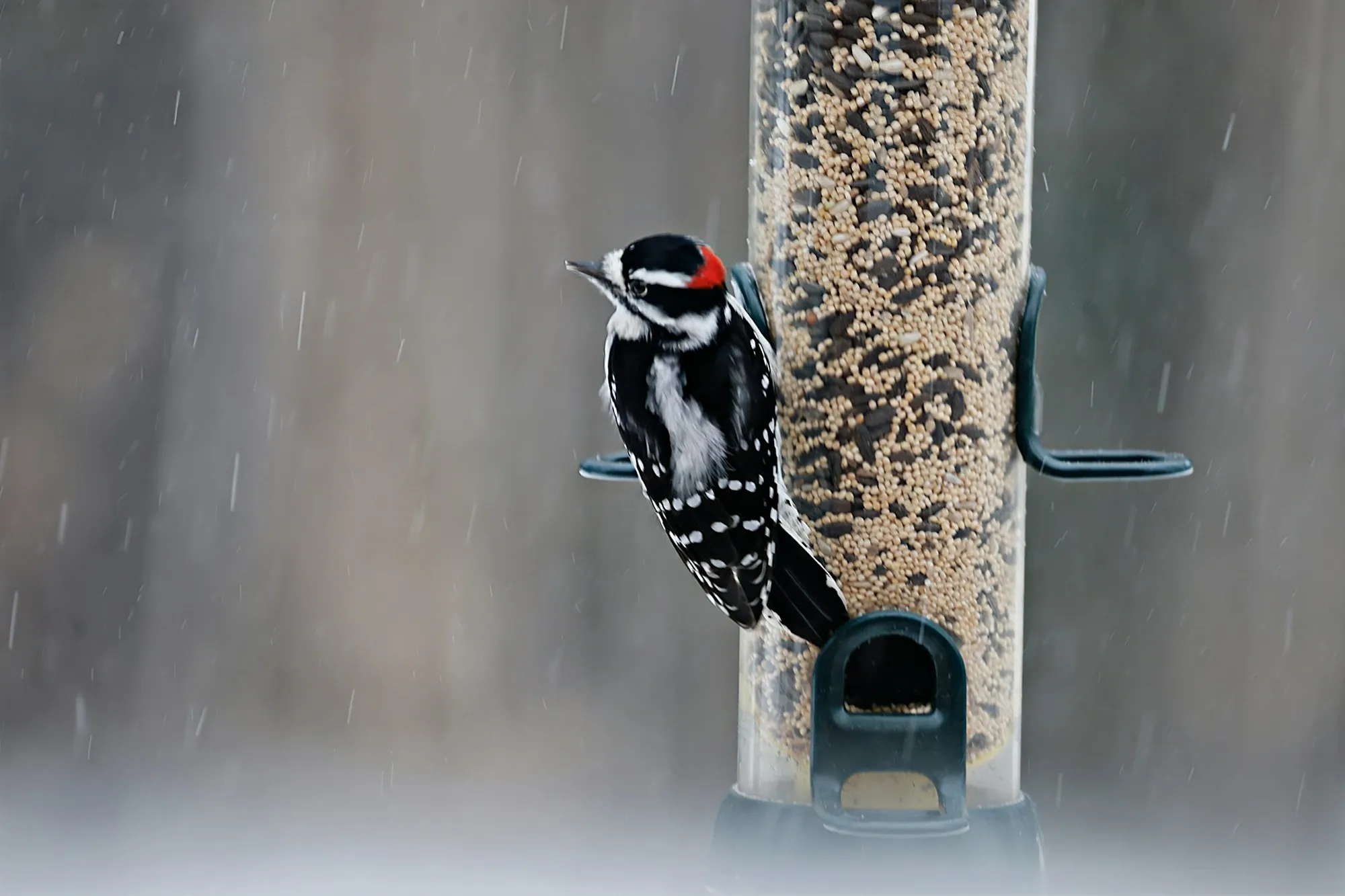
Short answer: Put the feeder about 5 feet off the ground, at least 10 feet from anything a squirrel can jump from, about 10 to 12 feet from dense cover, and either within 3 feet of a window or more than 30 feet away. Then make sure you can see it from where you sit.
That’s where to put a bird feeder in most US yards. Each number comes from Cornell Lab’s Project FeederWatch, university extension services or a field study. The sources don’t always agree, so the table below shows the range and who says what. The rules also pull against each other, so this guide gives you an order of priority.
How this page was made: This is a researched guide. Distances come from the sources linked in each section. We haven’t measured anything in a yard of our own. See how we test.
The placement rules at a glance
| Rule | Distance | Why | Source |
|---|---|---|---|
| Window distance | Under 3 ft, or over 30 ft | Birds near the glass can’t build up speed; birds far away are more likely to see it or turn | FeederWatch, Tufts |
| Squirrel jump-off points (trees, fences, roofs, rails) | At least 10 ft (Cornell, UNH); 7–8 ft (Nebraska) | Squirrels can jump to feeders closer than that | FeederWatch, UNH, Nebraska |
| Escape cover (shrubs, evergreens) | About 10 ft (Cornell, Penn State); 12 ft (Tufts) | Close enough for birds to flee hawks, far enough that cats can’t ambush | FeederWatch, Penn State, Tufts |
| Cat ambush spots | At least 10 ft | Keeps cats from striking from hiding | Nebraska Extension |
| Feeder height | About 5 ft; 6 ft+ where deer raid | Out of squirrel leap range from the ground; out of deer reach | Nebraska, Nebraska Extension |
| Pole baffle height | Top at 4–5 ft | Squirrels can’t jump over it from the ground | Wild Birds Unlimited |
Where sources give different numbers, we show the range rather than pick one.
- A, window feeder: within 3 feet of the glass, where birds can't build up speed.
- B, baffled pole: more than 30 feet from the window, at least 10 feet from the tree's branches (and from fences, rails and roofs), about 10 feet from shrub cover.
How to pick your spot in 5 steps
Work through these in order. Earlier steps protect birds, so they win when two rules clash.
Step 1: Check your windows (3 ft / 30 ft)
Project FeederWatch says most window strikes happen when feeders are between 3 and 30 feet from the glass. Within 3 feet, birds can’t build up enough speed to hurt themselves; beyond 30 feet, they’re more likely to see the window or take a different route (FeederWatch). Tufts Wildlife Clinic gives the same rule: “either more than 30 feet from a window or closer than three feet” (Tufts).
The field evidence points the same way. In a study by Klem and colleagues (Wilson Bulletin, 2004), none of the collisions were fatal when platform feeders were 1 meter (about 3 feet) from the window, and the share of fatalities rose with feeders at 5 and 10 meters (Klem et al. 2004).
If the only good spot is in the 3–30 ft band, treat the glass. American Bird Conservancy says markers go on the outside of the window, with gaps of 2 inches or less (ABC).
Step 2: Map squirrel launch points
Walk the yard and mark every trunk, overhanging branch, fence top, deck rail and roof edge. Your feeder needs to be at least 10 feet from all of them (FeederWatch; UNH Extension). Nebraska Extension uses 7 to 8 feet (Nebraska); 10 feet covers both.
This page treats squirrels as a placement constraint only. For baffles, pole systems and seed tactics, see keep squirrels off your feeder and our squirrel-proof bird feeder picks.
Step 3: Find cover at a safe distance
Birds want a refuge nearby. Project FeederWatch suggests placing feeders near trees or shrubs, says evergreens are ideal because they hide birds and block winter wind, and calls about 10 feet “a good compromise” between cover and jump-off points for squirrels and cats (FeederWatch). Penn State Extension says within 10 feet of protective cover (Penn State). Tufts uses 12 feet from a brush pile, evergreen or bush: close enough for birds to reach cover, far enough that predators can’t hide within striking range (Tufts).
For ground-feeding birds such as Song Sparrows, FeederWatch suggests loosely stacked brush piles near feeders as escape cover.
When steps 2 and 3 collide: a shrub 10 feet away is fine as cover. A tree with strong branches 10 feet away is also a launch point. Keep the feeder 10+ feet from the tree and let a lower shrub be the cover.
Step 4: Pick the view
Among the spots that pass steps 1–3, choose the one you can see from your kitchen, desk or favorite chair. Near-window placement (under 3 feet) gives the closest view and also passes step 1. A spot 30+ feet out works with binoculars or a camera feeder.
Step 5: Make refills easy in winter
Think about January. Can you reach the feeder without wading through a snowdrift? Is the ground underneath well drained, so spilled seed doesn’t sit in puddles? A feeder you can reach in two minutes gets refilled; one at the back fence often doesn’t. (This is practical advice, not a sourced rule.)
How high should a bird feeder be?
About 5 feet. Nebraska Extension says to put feeders about 5 feet above the ground so squirrels can’t leap up to them (Nebraska), and at least 6 feet high where deer are a problem (Nebraska Extension). On a pole, the top of the baffle should be 4 to 5 feet up with the feeder above it (Wild Birds Unlimited).
Ground and platform feeders are the exception: they sit low by design, so the 10-foot distance from cat cover matters more. Tufts suggests chicken wire or thorny branches around ground-level feeders (Tufts).
Where to put each type of feeder
| Feeder type | Height | Distance to cover | Notes |
|---|---|---|---|
| Tube or hopper | About 5 ft | About 10 ft | Baffled pole, 10 ft from launch points (Nebraska, FeederWatch) |
| Platform / ground | Ground to low tray | 10+ ft from cat cover; brush pile nearby | Protect with wire or thorny branches; offer small amounts (Tufts) |
| Window feeder | On the glass | n/a | Within 3 ft passes the window rule (FeederWatch) |
| Suet | Out of dog reach | Near a tree or post | Keep suet in shade so it doesn’t melt (Nebraska Extension) |
| Hummingbird | Where you can reach it to clean | Near perches | In hot weather, empty and clean it every day or every other day (Audubon) |
| Smart camera feeder | About 5 ft, on a baffled pole | About 10 ft | Needs 2.4 GHz Wi-Fi and sun on the panel (below) |
Placing a smart camera feeder
A camera feeder adds three checks to the five steps.
- Wi-Fi at the spot. Birdfy’s Feeder 2 series and the Birdbuddy Pro Solar both connect over 2.4 GHz Wi-Fi (Birdfy specs; Bird Buddy). Stand at the spot with your phone and check the signal before you dig a pole hole.
- Sun on the panel. The Birdfy Feeder 2 Pro (opens in a new tab) ships with a 3 W panel. In the US, a panel facing south with as little shade as possible gets the most winter sun.
- Don’t aim the lens into the low winter sun. Backlit birds are harder for the AI to identify.
Smart feeders aren’t squirrel-proof, so the 10-foot rule still applies. More in our smart feeder rankings and Bird Buddy vs Birdfy.
Hanging vs pole-mounting
- Hanging from a tree branch keeps the feeder in the jump zone almost by definition. UNH Extension says tilting or large dome-shaped baffles are best for feeders hung from branches (UNH).
- A pole with a baffle lets you put the feeder exactly where steps 1–3 say. Wild Birds Unlimited notes that most basic shepherd’s hooks aren’t tall enough to squirrel-proof a feeder (WBU). A stovepipe baffle such as the Squirrel Stopper Metal Standard Baffle (opens in a new tab) (27 in. tall, fits ½–2 in. poles, $69.95; not available to order at Duncraft on October 8, 2026) goes under the feeder (Duncraft).
Full baffle method: how to keep squirrels off a bird feeder.
Seasonal placement tips
- Winter: evergreen cover blocks wind, per FeederWatch. Keep the refill path clear. For what to fill it with, see what to feed birds in winter.
- Spring and fall migration: American Bird Conservancy says birds collide with glass all year, “but the pace picks up during spring and fall migration” (ABC). Recheck your 3/30-foot spacing before migration.
- Water nearby: Penn State Extension suggests a bath near a tree with overhanging branches where birds can preen, and away from dense shrubs where cats can hide (Penn State). For winter water, see best heated bird baths and how to keep a bird bath from freezing.
When to take feeders down
- Bears. Colorado Parks and Wildlife says not to hang bird feeders from April 15 to November 15, or to keep them 10 feet off the ground and 10 feet from climbable structures (CPW). New Hampshire Fish and Game says to stop feeding birds by April 1, and south of the White Mountains to consider removing feeders by March 15 or at the first spring-like weather, whichever comes first (NH Fish and Game). Rules differ by state, so check yours.
- Sick or dead birds. During a 2021 Salmonella outbreak linked to songbirds, the CDC advised: “If you find a sick or dead bird in your yard, remove any bird feeders and baths for two weeks and clean them outdoors.” It also advised cleaning feeders and baths weekly or when visibly dirty (CDC). Follow any current advisory from your state wildlife agency.
- A hawk keeps hunting your yard. Nebraska Extension suggests not feeding for a week or two so the hawk moves on (Nebraska Extension).
- HOA or local rules. Some communities restrict feeders; check before you install a pole.
Common placement mistakes
- Five to fifteen feet from a big window. That’s inside the 3–30 ft band.
- Hanging from the tree that is also the squirrels’ launch pad.
- Right next to a dense shrub, which gives cats an ambush spot. Leave about 10 feet.
- A short shepherd’s hook with no baffle.
- Out of sight from the house, so you never see the birds or notice the feeder is empty.
- Under-feeder clutter. Spilled seed keeps rodents and squirrels coming back. Hulled seed helps; see our bird seed guide.
Gear that helps
| Need | Option | Why |
|---|---|---|
| Squirrel-resistant feeder | Brome Squirrel Buster Plus (opens in a new tab) ($129.25, in stock Oct 8) | Adjustable weight spring, 5.1 lb capacity (Brome) |
| Pole baffle | Squirrel Stopper Metal Standard Baffle (opens in a new tab) ($69.95, not available to order at Duncraft Oct 8) | 27 in. stovepipe for ½–2 in. poles |
| Camera feeder | Birdfy Feeder 2 Pro (opens in a new tab) ($239.99) | 2.4 GHz Wi-Fi, 3 W solar panel included (Birdfy) |
Sun or shade?
For seed feeders, we couldn’t find an authoritative rule either way. Two practical points: a smart feeder’s solar panel needs sun, and Nebraska Extension suggests keeping suet in shade so it doesn’t melt.
Related
Frequently asked questions
- How high off the ground should a bird feeder be?
- About 5 feet is the common guidance. Nebraska Extension says to put feeders about 5 feet above the ground so squirrels can't leap up to them, and at least 6 feet high where deer are a problem. On a pole, the top of the baffle should sit 4 to 5 feet up, with the feeder above it.
- How far from a window should a bird feeder be?
- Either closer than 3 feet or farther than 30 feet, as Tufts Wildlife Clinic and Project FeederWatch advise. In a field study, no collisions were fatal when feeders were 1 meter (about 3 feet) from a window.
- How far from a tree should a bird feeder be to stop squirrels?
- At least 10 feet, according to Project FeederWatch and UNH Extension. Nebraska Extension uses 7 to 8 feet. Use 10 feet to be safe, and count overhanging branches, fences, deck rails and roofs too.
- Can I put a bird feeder near my house or on my deck?
- Yes, if it's within about 3 feet of the nearest window and you accept that squirrels can use deck rails and roofs as launch points. A window feeder or a feeder on a short arm next to the glass fits that rule.
- Should bird feeders be near a bird bath?
- Nearby works well. Penn State Extension suggests putting a bath near a tree with overhanging branches where birds can preen, and away from dense shrubs where cats can hide.

Written by
Research and editing
The Feeder Field editorial team researches backyard birding gear and bird feeding for US readers. We compare manufacturer specifications, subscription terms and long-term owner feedback, and we check feeding and bird-behavior advice against the Cornell Lab of Ornithology, Audubon and university extension services. Articles are drafted with the help of AI tools, then fact-checked and edited by our team before they go live. Every guide says whether it is researched or hands-on tested, and we update buying guides at least every six months.