Guide
Types of Bird Seed: Which Birds Eat What (and What to Skip)
Types of bird seed explained: black-oil sunflower, hearts, safflower, nyjer, millet, corn, peanuts and fillers, with which birds eat each and what research found.
ResearchedBy Feeder Field Editorial Team
Last updated
Disclosure: We may earn a commission when you buy through links on this page. Read our affiliate disclosure.
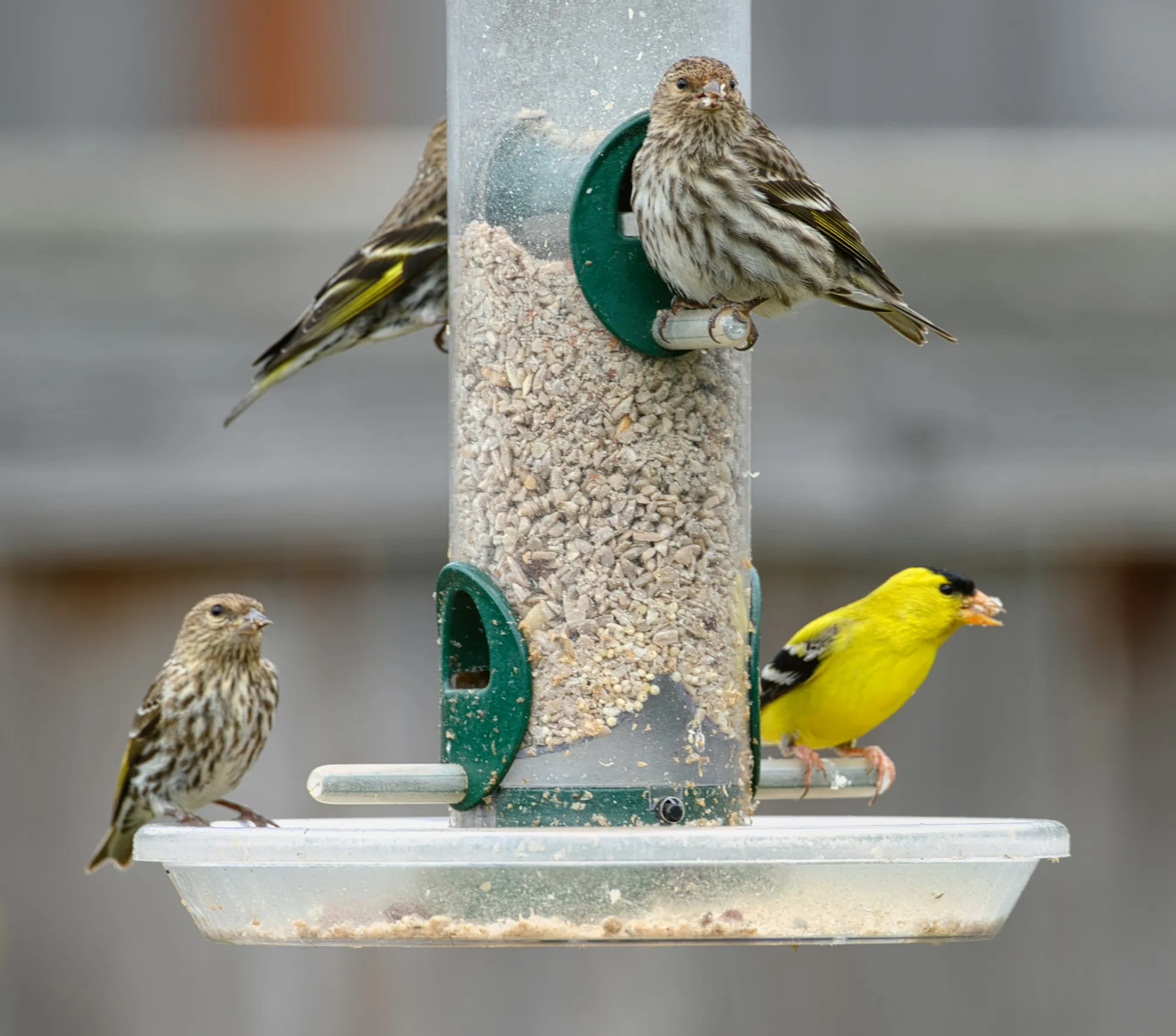
Short answer: if you buy one seed, buy black-oil sunflower. Its thin shells are easy for virtually all seed-eating birds to crack (All About Birds), and a 1980 US Fish and Wildlife Service feeder study found oil-type sunflower “superior to other foods” for most species (Geis 1980). Add white proso millet on a tray if you want sparrows, juncos and doves.
There are about a dozen types of bird seed sold in the US, and most bags are some mix of them. This guide covers each seed, which birds eat it, what the main study found, how to read a mix label, and how to compare cost per pound of seed birds actually eat.
How this page was made: This is a researched guide built on Cornell Lab (All About Birds and Project FeederWatch), Audubon and a 1980 US Fish and Wildlife Service feeding study, which we read in full. We haven’t counted birds at feeders of our own. See how we test.
Bird seed types at a glance
| Seed | Top birds (examples) | Feeder | Squirrel appeal | Shells / waste | Price tier* |
|---|---|---|---|---|---|
| Black-oil sunflower | Most feeder birds | Tube, hopper, platform | High | Shells | Low–mid |
| Striped sunflower | Jays, titmice, cardinals, grosbeaks | Hopper, platform | High | Thick shells | Mid |
| Sunflower hearts/chips | Goldfinches, finches, chickadees | Tube, hopper | High | None | High |
| Safflower | Cardinals | Hopper, platform, tube | Reported lower (varies) | Shells | Mid |
| Nyjer (thistle) | Goldfinches, siskins, redpolls | Nyjer tube or mesh sock | Low | Tiny hulls | High |
| White proso millet | Sparrows, juncos, doves, towhees | Ground tray, platform | Moderate | Small hulls | Low |
| Cracked corn | Doves, jays, quail, sparrows | Tray, small amounts | High | None | Low |
| Peanuts | Jays, titmice, chickadees, woodpeckers | Mesh feeder; platform for in-shell | High | Shells if in-shell | Mid–high |
| Milo, wheat, oats | Few (milo: some Western ground birds) | Ground, if at all | Varies | Mostly wasted in the East | Low |
*Price tiers are relative, based on Duncraft’s 5-lb bag prices (October 2026) where available. Bird sources are linked in each section below.
The main seed types
Black-oil sunflower
All About Birds says black-oil seeds have very thin shells, easy for virtually all seed-eating birds to crack, and kernels high in fat (All About Birds). In the Geis study, oil-type sunflower was “superior to other foods, including BSS [black striped sunflower], for most bird species.” Its smaller size also means 3 to 4 times as many seeds per unit weight (Geis 1980).
One option: Duncraft Black Oil Sunflower, 5-lb (opens in a new tab), $18.95, available to order when we checked on October 8, 2026 (Duncraft). Black-oil sunflower is sold almost everywhere bird seed is; any clean, fresh bag will do.
Striped sunflower
Striped seeds have a thicker shell, which All About Birds says is much harder for House Sparrows and blackbirds to crack. That’s its one real advantage. In the Geis study, “only tufted titmice and blue jays preferred BSS to other sunflower products,” and very few species preferred the gray striped type (Geis 1980).
Sunflower hearts and chips (no-mess)
Hulled sunflower (whole hearts or chips) leaves no shells. In the Geis study, hulled sunflower was among the most attractive foods for American Goldfinches, and the report calls it especially desirable “if one wishes to attract finches and eliminate the accumulation of husks.” Hulled seed spoils faster than seed in the shell, so buy smaller amounts and keep it dry (FeederWatch).
One option: Duncraft Whole Sunflower Hearts, 5-lb (opens in a new tab), $29.95, available to order when we checked on October 8, 2026 (Duncraft).
Safflower
All About Birds says safflower has a thick shell that’s hard for some birds to crack but is a favorite of cardinals. It adds that, according to some sources, House Sparrows, European Starlings and squirrels don’t like it, though in some areas they seem to have developed a taste for it. Audubon warns that safflower on wet ground “can quickly become soggy and inedible” (Audubon). Our squirrel guide covers safflower as a squirrel tactic.
One option: Duncraft Safflower, 5-lb (opens in a new tab), $24.95, available to order at Duncraft (checked October 8, 2026). Duncraft’s own FAQ says some squirrels, particularly red squirrels and chipmunks, may still eat it (Duncraft).
Nyjer (thistle)
Nyjer (also sold as niger or “thistle”) is the seed of Guizotia abyssinica, not a true thistle. All About Birds calls it a delicacy for small finches such as goldfinches, siskins and redpolls, and says to offer it in a feeder with small ports or fine mesh. In the Geis study, nyjer “demonstrated excellence as a goldfinch food,” and it drew “more than twice as many visits as would have been expected from the amount consumed,” which made it relatively efficient despite its price (Geis 1980).
Imported nyjer must be treated at an APHIS-approved facility before export or at the first US port of entry (USDA APHIS). Federal rules say this is because the seed is commonly contaminated with noxious weed seeds, including dodder (Cuscuta) (7 CFR 360.400).
White proso millet
All About Birds lists white millet as a favorite of ground-feeding birds such as quail, native sparrows, doves, towhees, juncos and cardinals. Geis found white proso millet “the best seed for use in attracting the small seed-eating species” and said it “should be the food of choice in any feeding program to attract dark-eyed juncos, mourning doves, and all species of sparrows” (Geis 1980). The catch: it was also the preferred food of Brown-headed Cowbirds and House Sparrows in the same study. Scatter it on a tray or the ground rather than in tube feeders.
Cracked corn
All About Birds says corn is eaten by many birds, from turkeys and quail to cardinals, jays and doves, but is also a favorite of House Sparrows, cowbirds, starlings, geese, bears, raccoons and deer. It calls corn the bird food most likely to carry aflatoxins, and advises never buying it in plastic bags, never letting it get wet, and offering only what birds eat in a day. In the Geis study, cracked corn was eaten only about one-third as often as white proso millet, and fine cracked corn did better than coarse (Geis 1980).
Peanuts (in-shell vs hearts)
All About Birds says peanuts are popular with jays, crows, chickadees, titmice and woodpeckers and, like corn, can harbor aflatoxins, so keep them dry and use them up quickly. Avoid salted or flavored peanuts (FeederWatch).
The Geis study split them sharply. Whole peanut kernels were “remarkably attractive” for their size, especially to titmice and Blue Jays. Peanut hearts (the small germ pieces common in cheap mixes) were “extremely attractive to starlings” and on the report’s list of “commonly used but essentially unattractive foods” for other birds.
Milo, wheat and other fillers
The Geis study found “fine cracked corn, wheat, sorghum, hulled oats, and rice” relatively unattractive and said milo “probably should not be used.” Rape seed received no visits by any species, and flax was “almost completely ignored” (Geis 1980).
Regional caveat: that study was done in Maryland, with a dark, brownish-red milo. All About Birds says some Western species, including jays, flock to red milo, and that it should be scattered on the ground or low trays. In the East, treat milo as filler. In the West, it may earn its place on a ground tray.
What the research says (Geis 1980)
The study: Aelred D. Geis, Relative Attractiveness of Different Foods at Wild Bird Feeders, US Fish and Wildlife Service Special Scientific Report–Wildlife No. 233, 1980, 11 pages. Catalog record (USGS) · Full text (Internet Archive)
How it worked: The report draws on more than 179,000 bird visits to experimental feeders between November 1977 and July 1979. Most data were collected near Clarksville, Maryland, with other observations in the Washington–Baltimore area. Foods were offered side by side so visits to each could be compared.
Key findings:
- Oil-type (black-oil) sunflower beat black striped and gray striped sunflower for most species.
- White proso millet was the best seed for small seed-eaters.
- Fine cracked corn, wheat, sorghum (milo), hulled oats and rice were relatively unattractive.
- Preferences differ so much between species that “it is difficult to formulate a mixture of seeds that would be efficient at all locations and at all times.”
Limits: It’s more than 45 years old and comes from one region. Treat it as strong evidence for Eastern feeders, not a universal ranking. Current Cornell and Audubon guidance agrees on the headline points.
How to read a bird seed mix label
Ingredients are listed by weight, heaviest first. Look at the first two or three.
Good signs:
- Black-oil sunflower, sunflower hearts or chips listed first
- White proso millet (for ground feeders)
- Nyjer, safflower or peanut pieces in finch or cardinal blends
Filler signs:
- Milo or “grain sorghum” near the top (in the East)
- Wheat, oats, rice, flax or rape seed
- “Red millet” listed ahead of white millet
- “Peanut hearts” (a starling favorite, per Geis)
- Vague terms like “grain products”
Audubon warns against “bad mixed seed” with “filler in it—junk seeds that most birds won’t eat,” naming wheat and certain red milo varieties (Audubon). Rejected seed ends up on the ground, where it feeds rodents and squirrels.
No-waste blends use only hulled seed. For example, Duncraft’s Super No-Waste Blend (opens in a new tab) lists hulled sunflower heart chips, peanut bits, cracked corn and nyjer, at $21.95 for 5 lb (available to order, checked October 8, 2026) (Duncraft). They cost more per pound but leave no shells to rake.
Cost per pound of seed birds actually eat
Shells weigh something, and birds drop them. So the fair comparison is cost per pound of kernel, not per pound of bag. We couldn’t find a current primary source (USDA or the National Sunflower Association) that publishes the shell share of black-oil sunflower sold as birdseed, so we won’t invent one. Here’s the method instead.
Formula: cost per edible lb = bag price ÷ bag weight ÷ kernel share
Worked example with Duncraft’s October 2026 list prices:
| Seed | Price | Per lb | Kernel share | Cost per edible lb |
|---|---|---|---|---|
| Black-oil sunflower, 5 lb | $18.95 | $3.79 | Unknown (K) | $3.79 ÷ K |
| Whole sunflower hearts, 5 lb | $29.95 | $5.99 | 100% (no shell) | $5.99 |
The break-even: hearts are cheaper per edible pound if black-oil’s kernel share is below $3.79 ÷ $5.99, or about 63%. If you know the kernel share of the seed you buy, you can decide in one line. Run the same math with your local prices; they vary widely by store and bag size.
Hearts also save you raking shells, which some people value more than the price difference.
Which seed for which bird
What each species preferred in the Geis feeding trials (Maryland), with All About Birds or Audubon notes where they add something.
| Bird | Black-oil sunflower | Striped sunflower | Hulled sunflower | Safflower | Nyjer | Millet | Corn | Peanuts |
|---|---|---|---|---|---|---|---|---|
| American Goldfinch | Preferred in Geis 1980 | Not listed | Preferred in Geis 1980 | Not listed | Preferred in Geis 1980 | Not listed | Not listed | Not listed |
| House Finch | Preferred in Geis 1980 | Not listed | Not listed | Not listed | Also eats (Cornell or Audubon) | Not listed | Not listed | Not listed |
| Purple Finch | Preferred in Geis 1980 | Not listed | Not listed | Not listed | Also eats (Cornell or Audubon) | Not listed | Not listed | Not listed |
| Evening Grosbeak | Preferred in Geis 1980 | Not listed | Not listed | Also eats (Cornell or Audubon) | Not listed | Not listed | Not listed | Not listed |
| Northern Cardinal | Preferred in Geis 1980 | Preferred in Geis 1980 | Not listed | Also eats (Cornell or Audubon) | Not listed | Also eats (Cornell or Audubon) | Not listed | Not listed |
| Carolina Chickadee | Preferred in Geis 1980 | Not listed | Not listed | Not listed | Not listed | Not listed | Not listed | Also eats (Cornell or Audubon) |
| Tufted Titmouse | Preferred in Geis 1980 | Preferred in Geis 1980 | Not listed | Not listed | Not listed | Not listed | Not listed | Preferred in Geis 1980 |
| Blue Jay | Not listed | Preferred in Geis 1980 | Not listed | Not listed | Not listed | Not listed | Also eats (Cornell or Audubon) | Preferred in Geis 1980 |
| Red-bellied Woodpecker | Not listed | Preferred in Geis 1980 | Not listed | Not listed | Not listed | Not listed | Not listed | Also eats (Cornell or Audubon) |
| Mourning Dove | Preferred in Geis 1980 | Not listed | Not listed | Not listed | Not listed | Preferred in Geis 1980 | Also eats (Cornell or Audubon) | Not listed |
| Dark-eyed Junco | Not listed | Not listed | Not listed | Not listed | Not listed | Preferred in Geis 1980 | Not listed | Not listed |
| Song Sparrow | Not listed | Not listed | Not listed | Not listed | Not listed | Preferred in Geis 1980 | Not listed | Not listed |
| White-throated Sparrow | Preferred in Geis 1980 | Preferred in Geis 1980 | Not listed | Not listed | Not listed | Preferred in Geis 1980 | Not listed | Not listed |
| White-crowned Sparrow | Preferred in Geis 1980 | Not listed | Not listed | Not listed | Not listed | Preferred in Geis 1980 | Not listed | Not listed |
| American Tree Sparrow | Not listed | Not listed | Not listed | Not listed | Not listed | Preferred in Geis 1980 | Preferred in Geis 1980 | Not listed |
| Common Grackle | Not listed | Not listed | Preferred in Geis 1980 | Not listed | Not listed | Not listed | Preferred in Geis 1980 | Not listed |
| Brown-headed Cowbird | Not listed | Not listed | Not listed | Not listed | Not listed | Preferred in Geis 1980 | Also eats (Cornell or Audubon) | Not listed |
| House Sparrow | Not listed | Not listed | Not listed | Not listed | Not listed | Preferred in Geis 1980 | Also eats (Cornell or Audubon) | Not listed |
| European StarlingGeis: peanut hearts, hulled oats | Not listed | Not listed | Not listed | Not listed | Not listed | Not listed | Also eats (Cornell or Audubon) | Not listed |
Sources: Geis 1980, All About Birds, Audubon.
Matching seed to feeder
| Seed | Best feeder |
|---|---|
| Black-oil sunflower | Tube, hopper, platform; works in squirrel-resistant feeders such as those in our squirrel-proof bird feeder guide |
| Hearts and chips | Covered tube or hopper; keep dry |
| Nyjer | Nyjer tube with tiny ports, or fine-mesh sock |
| Millet, corn, milo | Ground tray or platform, small amounts |
| Peanuts | Mesh peanut feeder (shelled); platform (in-shell) |
| Safflower | Hopper, platform or tube |
Seed for a camera feeder: a single seed such as black-oil sunflower draws the widest range of species for your clips. See our smart feeder rankings.
Seed and squirrels
Seed choice helps a little; placement helps a lot. Safflower is the usual squirrel-unfriendly seed, with the hedges above, and Audubon notes that cracked corn also appeals to squirrels. For the full plan, see how to keep squirrels off your bird feeder, squirrel-proof feeders and where to put a bird feeder.
Winter seed choices
In winter, lead with black-oil sunflower for its fat content, add suet for woodpeckers, nuthatches and chickadees, and put millet on a tray for juncos and sparrows. The full list, with what to avoid, is in what to feed birds in winter. Open water matters too: see best heated bird baths.
Storing bird seed
- Keep it dry and sealed. A metal bin with a tight lid keeps out moisture and rodents. All About Birds says never to buy corn in plastic bags and never let it get wet.
- Know the aflatoxin risk. In a survey of 142 bags of wild bird seed bought in Texas in 1999, 17% had aflatoxin above 100 µg/kg, and 83% of those contained corn (Journal of Wildlife Diseases).
- Buy what you’ll use. Hulled seed spoils faster than seed in the shell (FeederWatch).
- Throw out anything clumped, musty or moldy.
Related
Frequently asked questions
- What is the best bird seed to attract the most birds?
- Black-oil sunflower. All About Birds says its thin shells are easy for virtually all seed-eating birds to crack, and a 1980 US Fish and Wildlife Service study found oil-type sunflower superior to other foods, including striped sunflower, for most species. Add white proso millet on a tray for sparrows, juncos and doves.
- What's the difference between black-oil and striped sunflower seed?
- Black-oil seeds are smaller with thinner shells and high fat content. Striped seeds have thicker shells that All About Birds says are much harder for House Sparrows and blackbirds to crack. In the 1980 Geis study, only Tufted Titmice and Blue Jays preferred black striped sunflower to other sunflower products.
- Is nyjer the same as thistle?
- No. Nyjer, often sold as thistle or niger, is the seed of Guizotia abyssinica, a plant from Africa and Asia, not a true thistle. Federal rules say imported niger seed is commonly contaminated with noxious weed seeds such as dodder, so it must be treated before or on arrival in the US.
- Which bird seed do squirrels not eat?
- Safflower is the usual answer, but All About Birds hedges it: according to some sources squirrels don't like it, yet in some areas they seem to have developed a taste for it. Seed alone won't stop squirrels; placement and a baffle matter more.
- Why do birds throw seed out of the feeder?
- Often they're sorting past ingredients they don't want. The 1980 Geis study called wheat, milo, peanut hearts, hulled oats and rice commonly used but essentially unattractive, and Audubon warns that cheap mixes contain filler most birds won't eat.
- How do I keep blackbirds and House Sparrows off my feeder with seed choice?
- All About Birds says striped sunflower's thick shell is much harder for House Sparrows and blackbirds to crack, and, according to some sources, House Sparrows and starlings don't like safflower. Keep millet, cracked corn and peanut hearts out of hanging feeders; House Sparrows, cowbirds and starlings favored them in the Geis study.
- Does bird seed go bad?
- Yes. Store it dry, sealed and cool. All About Birds warns that corn is the bird food most likely to carry aflatoxins, which are toxic even at low levels, and peanuts carry the same risk. Hulled seed spoils faster than seed in the shell. Throw out anything damp, clumped or moldy.
- Will bird seed sprout under my feeder?
- Seed in the shell can. Hulled seed (sunflower hearts or chips) is sold as no-sprout because the germinating shell is removed. Imported nyjer must be treated before it enters the US.

Written by
Research and editing
The Feeder Field editorial team researches backyard birding gear and bird feeding for US readers. We compare manufacturer specifications, subscription terms and long-term owner feedback, and we check feeding and bird-behavior advice against the Cornell Lab of Ornithology, Audubon and university extension services. Articles are drafted with the help of AI tools, then fact-checked and edited by our team before they go live. Every guide says whether it is researched or hands-on tested, and we update buying guides at least every six months.