Guide
What to Feed Birds in Winter (and What to Avoid)
The best winter bird foods for US yards: sunflower, suet, peanuts, safflower, nyjer, millet. Which birds eat each, the right feeder, and what to skip.
ResearchedBy Feeder Field Editorial Team
Last updated
Disclosure: We may earn a commission when you buy through links on this page. Read our affiliate disclosure.
Short answer: the top 5 winter bird foods
- Black-oil sunflower seed: nearly every feeder bird eats it (Audubon)
- Suet: high-fat energy for woodpeckers, nuthatches, chickadees and titmice (Audubon)
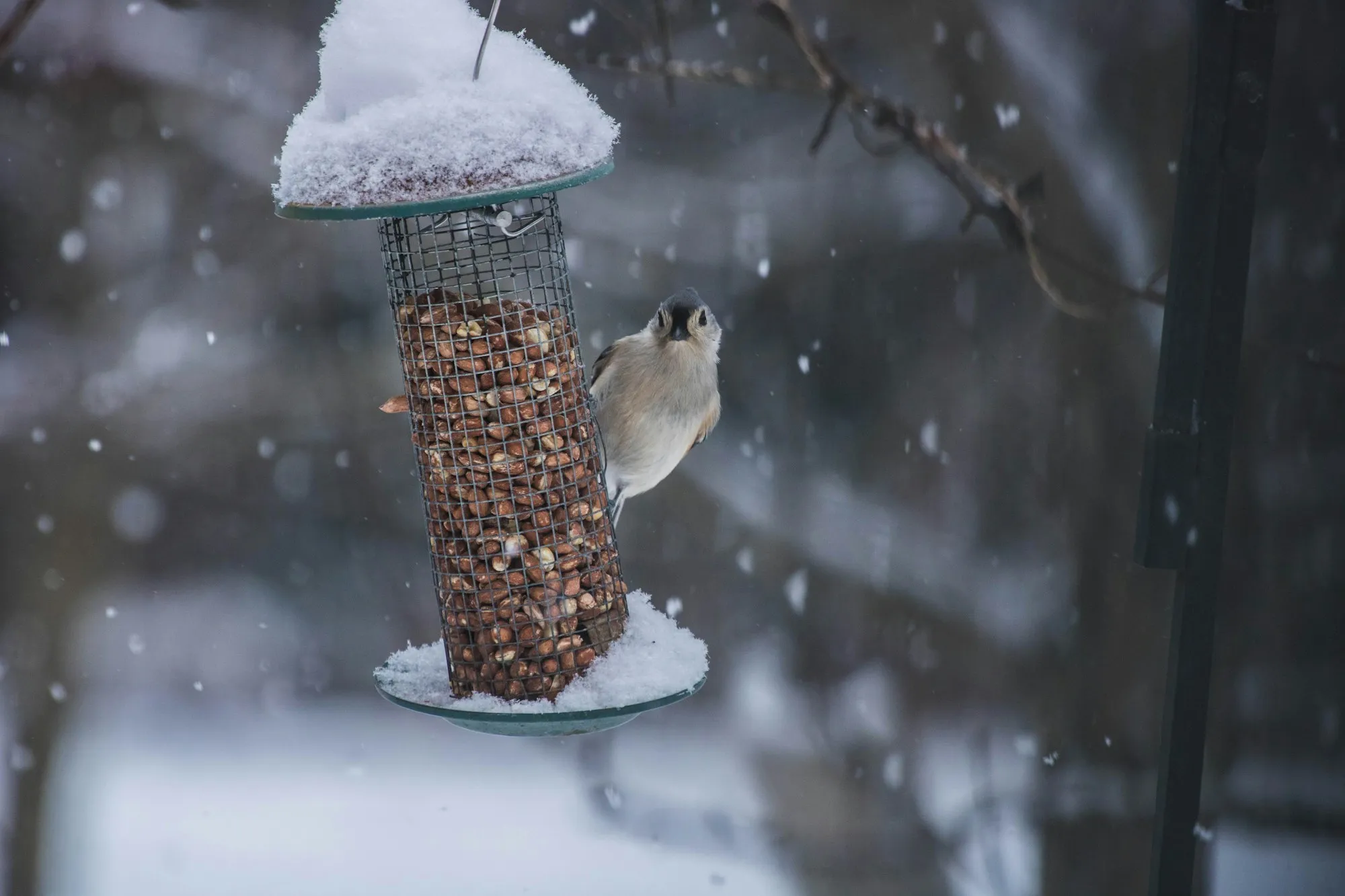
- Peanuts: shelled, dry-roasted and unsalted (Audubon)
- Safflower: a cardinal food that some sources say squirrels and starlings dislike (All About Birds)
- Nyjer (thistle): for goldfinches, Pine Siskins and redpolls (Audubon)
Skip: bread, salted or flavored foods, and anything moldy.
If you’re deciding what to feed birds in winter and can only buy one thing, make it a bag of black-oil sunflower seed. Then add suet for woodpeckers, and open water for everyone.
How this page was made: This is a researched guide built on the Cornell Lab of Ornithology (All About Birds and Project FeederWatch) and the National Audubon Society. Each food-and-bird pairing links to its source. It covers US birds only. See our editorial policy.
Why winter feeding helps
Audubon notes that birds often rely most on feeders in winter, when food is scarce, though some species also use them during migration and nesting (Audubon). Short days leave fewer hours to find food, and freezing weather locks up water.
Feeders are a supplement, not a lifeline. In a study of Black-capped Chickadees at two Wisconsin sites (winters 1983–1985), birds that used feeders got about 21% of their daily energy from them and the rest from natural food (Conservation Evidence summary of Brittingham & Temple). In related work, chickadees survived as well as non-feeder birds when feeders were removed in normal winter weather. In severe cold below about 10°F, however, feeder access nearly doubled their survival (National Wildlife Federation). Missing a few mild days won’t strand your birds, but cold snaps are when a full feeder matters most.
The best winter bird foods
Black-oil sunflower seed
Who eats it: Nearly every bird that visits a feeder, according to Audubon, which calls it “the hamburger of the bird world” (Audubon).
Why it works in winter: The shells are thin enough for virtually all seed-eating birds to crack, and the kernels are high in fat, which All About Birds calls “extremely valuable for most winter birds” (All About Birds).
Feeder: Tube, hopper or platform.
Tip: Hulled sunflower (“hearts” or “chips”) leaves no shells under the feeder, but FeederWatch notes it spoils faster than seed in the shell, so keep it dry (FeederWatch).
Suet
Who eats it: Audubon lists woodpeckers, titmice, nuthatches and chickadees at suet feeders, and occasionally wrens, creepers and warblers (Audubon).
Why it works in winter: It’s dense fat and energy, and cold weather is when it keeps best. Cornell’s All About Birds says raw suet goes rancid quickly above freezing and should be offered only in winter. Rendered suet keeps better but can still soften in warm weather (All About Birds).
Feeder: A cage suet feeder. A tail-prop model helps larger woodpeckers. If squirrels raid your suet, a weight-activated suet feeder such as the Brome Squirrel Buster Suet (opens in a new tab) (holds two cakes, $109.95 on Brome’s store) is designed to close access under a squirrel’s weight.
Store-bought vs homemade: Store-bought cakes are convenient and consistent. Audubon also publishes a homemade recipe, “Zick Dough,” as a winter treat (Audubon).
Peanuts
Who eats them: Woodpeckers, jays, nuthatches, chickadees, titmice, cardinals and finches (Audubon).
How to serve: Audubon says to offer peanuts de-shelled, dry-roasted and unsalted. FeederWatch says to avoid salted peanuts and peanuts roasted with coatings or flavorings, and to throw out moldy peanut hearts right away (FeederWatch). Shelled peanuts in a mesh feeder suit smaller birds. Whole in-shell peanuts belong on a platform.
Safflower
Who eats it: A cardinal favorite. Some grosbeaks, chickadees, doves and native sparrows eat it too (All About Birds).
Why use it: All About Birds says that, according to some sources, House Sparrows, European Starlings and squirrels don’t like safflower, though in some areas they seem to have developed a taste for it.
Watch for: Audubon warns that safflower left on wet ground quickly turns soggy and inedible, so use a covered feeder and offer small amounts.
Nyjer (thistle)
Who eats it: The small finches: American Goldfinches, House, Purple and Cassin’s Finches, Pine Siskins and redpolls (Audubon).
Feeder: A tube feeder with small holes, or a fine-mesh thistle sock. Nyjer is small and pricey, so a dedicated feeder cuts waste. Keep it dry, because wet seed clumps.
Millet and cracked corn (for ground feeders)
Who eats them: White proso millet is a favorite of ground-feeding birds, including quail, native sparrows, doves, towhees, juncos and cardinals (All About Birds). Cracked corn draws sparrows, blackbirds, jays, doves and quail (Audubon).
Trade-offs: Millet also draws cowbirds, other blackbirds and House Sparrows, and Audubon notes cracked corn attracts squirrels. Scatter small amounts on a platform or low tray and clear leftovers.
Skip red milo: FeederWatch says most birds don’t favor it and it often goes to waste. Audubon counts mixes padded with milo, wheat or filler as “bad” seed.
Mealworms and fruit
Mealworms: FeederWatch calls them a high-protein treat and one of the only foods that reliably attracts bluebirds (FeederWatch). Audubon says most feeder birds eat them, goldfinches excepted, and suggests a shallow, slippery-sided dish.
Fruit: Audubon lists grapes, citrus, apples and bananas, and suggests chopping raisins and soaking them in warm water first. Remove fruit that molds: FeederWatch warns some molds make toxins harmful to birds.
Food, bird and feeder pairing table
| Food | US birds that eat it (examples) | Best feeder | Source |
|---|---|---|---|
| Black-oil sunflower | Nearly every feeder bird | Tube, hopper, platform | Audubon; All About Birds |
| Suet | Woodpeckers, titmice, nuthatches, chickadees | Suet cage | Audubon |
| Peanuts (unsalted) | Woodpeckers, jays, nuthatches, chickadees, titmice, cardinals, finches | Mesh peanut feeder; platform for in-shell | Audubon |
| Safflower | Northern Cardinal, some grosbeaks, chickadees, doves, native sparrows | Hopper, platform, tube | All About Birds |
| Nyjer | American Goldfinch, House, Purple and Cassin’s Finch, Pine Siskin, redpolls | Small-port finch tube or sock | Audubon |
| White proso millet | Juncos, native sparrows, doves, towhees, cardinals, quail | Ground tray, platform | All About Birds |
| Cracked corn | Sparrows, blackbirds, jays, doves, quail | Ground tray, platform | Audubon |
| Mealworms | Bluebirds and most feeder birds (not goldfinches) | Shallow dish | FeederWatch; Audubon |
| Fruit | Fruit-eating birds such as robins, waxwings and bluebirds | Platform, spike | Audubon; FeederWatch |
| Food and feeder | Woodpeckers | Chickadees | Titmice | Nuthatches | Cardinals | Jays | Finches | Sparrows & juncos | Doves | Bluebirds |
|---|---|---|---|---|---|---|---|---|---|---|
| Black-oil sunflowerTube, hopper, platform | Nearly every feeder bird (Audubon) | |||||||||
| SuetSuet cage | Yes | Yes | Yes | Yes | Not listed | Not listed | Not listed | Not listed | Not listed | Not listed |
| Peanuts (unsalted)Mesh feeder; platform for in-shell | Yes | Yes | Yes | Yes | Yes | Yes | Yes | Not listed | Not listed | Not listed |
| SafflowerHopper, platform, tube | Not listed | Yes | Not listed | Not listed | Yes | Not listed | Not listed | Yes | Yes | Not listed |
| Nyjer (thistle)Small-port finch tube or sock | Not listed | Not listed | Not listed | Not listed | Not listed | Not listed | Yes | Not listed | Not listed | Not listed |
| White proso milletGround tray, platform | Not listed | Not listed | Not listed | Not listed | Yes | Not listed | Not listed | Yes | Yes | Not listed |
| Cracked cornGround tray, platform | Not listed | Not listed | Not listed | Not listed | Not listed | Yes | Not listed | Yes | Yes | Not listed |
| MealwormsShallow dish | Also most feeder birds, not goldfinches | Yes | ||||||||
| FruitPlatform, spike | Also robins and waxwings | Yes | ||||||||
For a deeper look at each seed, including black-oil vs striped sunflower, see our guide to types of bird seed and All About Birds’ quick guide to types of bird seed.
What not to feed birds
- Bread, crackers and similar. Bread is poor nutrition, and Audubon California links bread to “angel wing,” a wing deformity in young waterfowl (Audubon California).
- Salted or flavored foods. No salted peanuts, and no peanuts roasted with coatings or flavorings (FeederWatch).
- Moldy anything. Moldy fruit and peanuts can carry toxins. Clumped, damp seed belongs in the trash, not the feeder.
- Cheap filler mixes. Audubon says most birds reject the filler, dyed pet-bird seed, wheat and red milo in cheap mixes. Rejected seed ends up on the ground, where it feeds rodents and squirrels.
- Homemade additives. Don’t mix pepper, oils or other products into seed. Their effects on birds haven’t been studied.
Don’t forget water
Audubon notes that many birds drink and bathe in open water even in frigid weather. It recommends a plastic bath with a built-in heater over ceramic, which can crack in the cold (Audubon).
A thermostatically controlled bath such as the API 14” Heated Bird Bath (opens in a new tab) uses 70 watts and is tested by its maker to -20°F (Miller Manufacturing). See all our picks in best heated bird baths, or, without power, how to keep a bird bath from freezing.
Keeping winter feeders clean and dry
Busy winter feeders get dirty fast, and crowded feeders can spread disease.
- Clean regularly, and more often in wet weather or heavy use. In a study reported by Project FeederWatch, a 10-minute soak in 1 part bleach to 9 parts water removed more Salmonella than scrubbing with soap and water alone. Feeders with leftover debris held more bacteria after cleaning, so scrub first (FeederWatch).
- Pick feeders that come apart fully, so you can scrub every surface.
- Keep seed dry. Use covered feeders, put out only what birds eat in a few days, and store seed in a sealed container.
- Rake up hulls and spilled seed under feeders.
When to start and stop winter feeding
- Start: Any time in fall. Wisconsin chickadees used feeders most in autumn in the Brittingham and Temple study, so a feeder up by October or November is in place before the hardest weather.
- Keep it steady in cold snaps: Birds get most of their food elsewhere, so a few missed mild days won’t hurt. Severe cold is when feeders made the biggest difference in the Wisconsin research.
- Stop in bear country by early spring. Bears raid feeders after they leave their dens. New Hampshire Fish and Game, for example, says to stop feeding birds by April 1, and to consider removing feeders by March 15 south of the White Mountains or at the first spring-like weather, whichever comes first (NH Fish and Game). Check your state wildlife agency’s dates.
- Stop raw suet when it warms up. All About Birds says to offer raw suet only in winter.
By region
Short starting points. To see which species to expect where you live, check the range maps on each species’ page in All About Birds.
- Northeast: Black-capped Chickadees are the chickadee across most of the region. Dark-eyed Juncos arrive as winter sets in over most of the eastern US and gather at feeders, where they seem to prefer millet (All About Birds: Dark-eyed Junco). Lead with black-oil sunflower and suet, and add millet on a ground tray.
- Midwest: A similar mix, with long, cold stretches when suet and open water matter most (see suet and water above).
- Southeast: Carolina Chickadees replace Black-capped across most of the region; the two meet in a narrow strip across the eastern US (All About Birds: Carolina Chickadee). Offer safflower and sunflower for cardinals, plus mealworms for bluebirds.
Recommended gear
| Need | Our pick | Why |
|---|---|---|
| Squirrel-resistant seed feeder | Brome Squirrel Buster Plus (opens in a new tab) | Adjustable weight spring, 5.1 lb capacity (Brome). More in best squirrel-proof bird feeders |
| Suet feeder squirrels can’t easily empty | Brome Squirrel Buster Suet (opens in a new tab) | Weight-activated, holds 2 cakes, $109.95 (Brome) |
| Open water | API 14” Heated Bird Bath (opens in a new tab) | 70 W, thermostat, maker-tested to -20°F (Miller). More in best heated bird baths |
Related
Sources
- Audubon: Top 10 foods for winter bird feeding, Audubon guide to winter bird feeding, Homemade suet (Zick Dough), Winterize your yard for birds, Audubon California on bread
- Cornell Lab: All About Birds, types of bird seed, All About Birds, suet, mealworms and other foods, Project FeederWatch, food types, Project FeederWatch, cleaning feeders, All About Birds species pages for the Dark-eyed Junco and Carolina Chickadee
- Chickadee feeder research: Conservation Evidence summary of Brittingham & Temple (1992), National Wildlife Federation, “Little Dynamo”
- New Hampshire Fish and Game, bear attractants
- Products: Brome Bird Care feeders, Miller Manufacturing 14” heated bird bath
Frequently asked questions
- Is it OK to feed birds bread?
- No. Bread is poor nutrition for birds, and Audubon California links bread to 'angel wing,' a wing deformity in young waterfowl. Offer black-oil sunflower, suet or unsalted peanuts instead.
- Should I feed birds every day in winter, and will they depend on me?
- Feed consistently if you can, but don't worry about dependence. In Wisconsin research, Black-capped Chickadees got about 21% of their daily energy from feeders, and when feeders were removed in normal winter weather they survived as well as chickadees that never used feeders. Feeders helped most in severe cold, so keep them stocked during cold snaps.
- Is suet bad in warm weather and OK in winter?
- For raw suet, yes. Cornell's All About Birds says raw suet goes rancid quickly above freezing and should be offered only in winter. Rendered suet cakes keep better but can still soften and coat feathers in warm weather. Winter is the ideal time for suet.
- What do birds eat in winter in nature?
- Seeds, berries and fruit left on plants, plus insects and spiders hidden in bark and leaf litter. Audubon suggests planting berry-producing natives such as dogwoods, hollies, chokeberries and serviceberry, and raking fallen leaves under shrubs as mulch for ground-feeding birds.
- Can I put out kitchen scraps?
- Some, with care. Audubon lists grapes, citrus, apples and bananas, and suggests chopping and soaking raisins in warm water first. Avoid bread, salted or flavored foods, and anything moldy: FeederWatch warns that some molds produce toxins harmful to birds.

Written by
Research and editing
The Feeder Field editorial team researches backyard birding gear and bird feeding for US readers. We compare manufacturer specifications, subscription terms and long-term owner feedback, and we check feeding and bird-behavior advice against the Cornell Lab of Ornithology, Audubon and university extension services. Articles are drafted with the help of AI tools, then fact-checked and edited by our team before they go live. Every guide says whether it is researched or hands-on tested, and we update buying guides at least every six months.