Guide
How to Keep a Bird Bath From Freezing (Safe Methods That Work)
How to keep a bird bath from freezing: thermostatic de-icers and heated baths, plus no-electricity options, what each costs to run, and what never to add.
ResearchedBy Feeder Field Editorial Team
Last updated
Disclosure: We may earn a commission when you buy through links on this page. Read our affiliate disclosure.
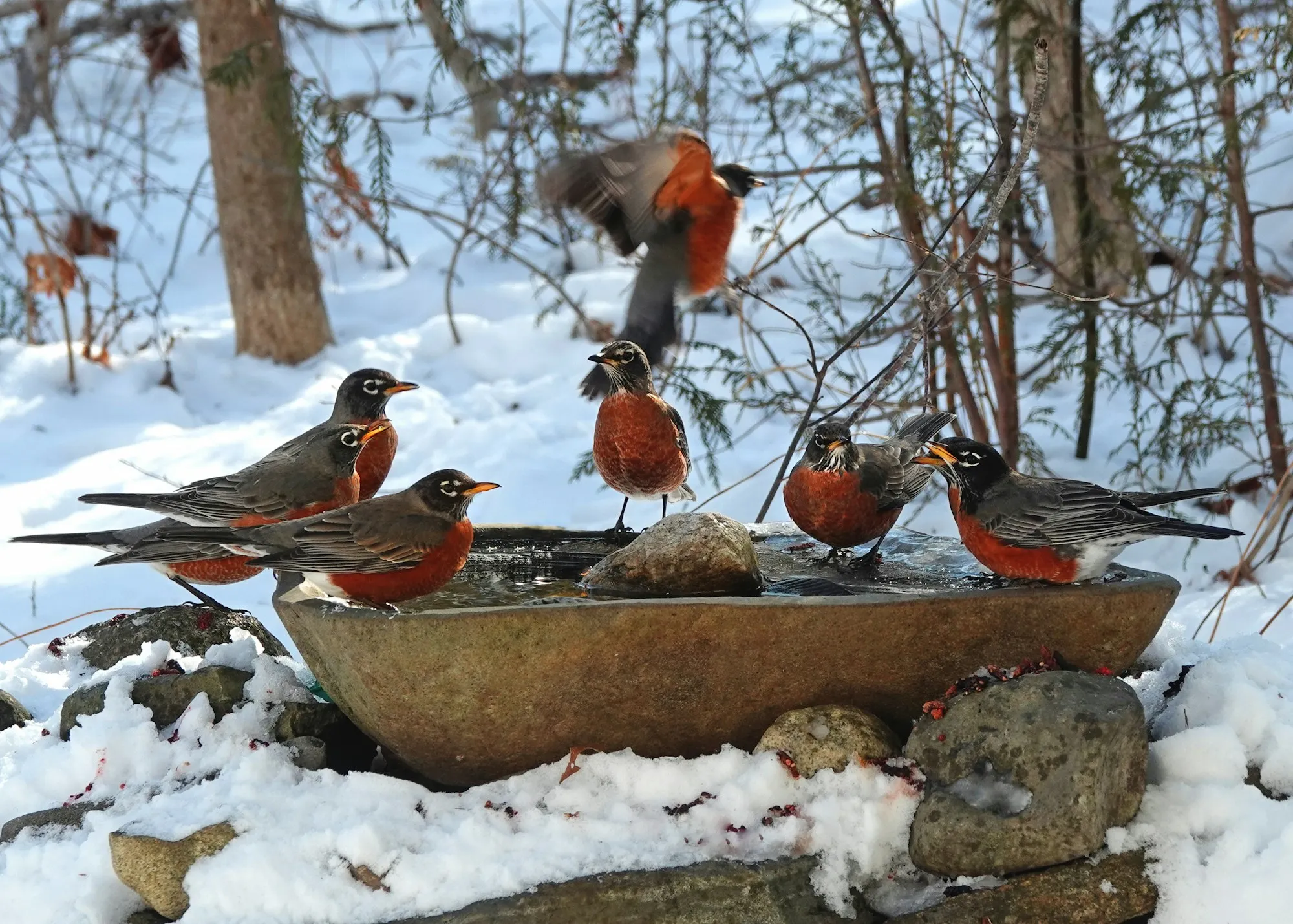
Short answer: The most reliable way to keep a bird bath from freezing is a thermostatic de-icer or a heated bird bath (see our best heated bird baths). Without power, swap in fresh water every morning and put the bath in sun, out of the wind. Never add antifreeze, glycerin or salt.
Below: every common method by how much cold it handles and what it costs, plus safety rules and what never to add.
How this page was made: This is a researched guide. We haven’t kept a bath open through a winter ourselves or measured water temperatures. Ratings come from manufacturers and from guidance by Audubon, the National Wildlife Federation and Cornell Lab. See how we test.
Methods compared
Ratings below are guidance based on the cited sources and makers’ published cold ratings, not our measurements. Where no source supports a rating, we say “no reliable data.”
| Method | Light frost (28–32°F) | Hard freeze (teens) | Deep cold (single digits and below) | Cost to run |
|---|---|---|---|---|
| Heated bath, thermostatic | Yes | Yes | To the maker’s rating (API 14B: −20°F; BD-75: −10°F) | ~$9–$20 per 30 days nonstop (70–150 W) |
| De-icer in your bath, thermostatic | Yes | Yes | API says “sub-zero”; no figure published | ~$26–$33 per 30 days nonstop (200–250 W) |
| Moving water (bubbler, pump) | No reliable data | No reliable data | No reliable data | Varies |
| Two-bowl daily swap | Yes, with daily swaps | Partly: refreezes during the day | No | $0 |
| Sun and wind shelter | Helps | No reliable data | No | $0 |
| Dark basin or black stones | No reliable data | No reliable data | No | $0 |
| Solar heater | No reliable data | No reliable data | No reliable data | $0 |
| Floating ball | No reliable data | No reliable data | No | $0 |
Sources: API 14B, Farm Innovators BD-75, API de-icer, NWF, EIA. Costs use the formula in the cost section.
Methods with electricity
Bird bath de-icer (drop-in heater)
A de-icer sits in the bath you already own and runs only when the water is cold enough.
The API Bird Bath De-Icer (300) (opens in a new tab) is 200 watts with a built-in thermostat, works in pottery, plastic and concrete baths up to 15 gallons, is cULus listed, and is described by the maker as keeping baths ice-free in sub-zero temperatures. It cost $89.99 on October 8, 2026 (Miller Manufacturing).
The Farm Innovators C-250 (opens in a new tab) is a 250 W cast-aluminum de-icer that Farm Innovators says is UL endorsed and safe in all birdbaths; its thermostat turns on at 35°F and off at 45°F (Farm Innovators).
Good for: a plastic or concrete bath you like. Not for: ceramic, which Audubon says can crack in cold weather (Audubon).
Heated bird bath
A heated bath has the heater built into a plastic basin, usually at lower wattage than a de-icer.
| Bath | Watts | Thermostat | Maker’s cold rating | Price |
|---|---|---|---|---|
| API 14” Heated Bird Bath (14B) (opens in a new tab) | 70 | Yes | Tested to -20°F | $135.99 list (maker sold out Oct 8; on Amazon) |
| API Deck-Mounted (650) (opens in a new tab) | 150 | Per retailer listings; not on maker’s page | Not stated by maker | $149.99 (Oct 7) |
| Farm Innovators BD-75 (opens in a new tab) | 75 | Yes (on 35°F, off ~45°F) | Tested at -10°F | $89.95 at Duncraft (Oct 7) |
| Farm Innovators HBI-150 (opens in a new tab) | 150 | Yes | Not stated | $119.95 at TreeHelp (Oct 7) |
Sources: API 14B, API 650, Farm Innovators, Duncraft, TreeHelp.
We compare these in detail, with pros and cons, in our best heated bird baths guide. This page doesn’t rank them.
Moving water: bubblers and pumps
We couldn’t find a bubbler, fountain pump or “water wiggler” maker that publishes a below-freezing operating rating. Check your pump’s manual before leaving it out in winter.
Methods without electricity
Two-bowl daily swap
The simplest no-power method. The National Wildlife Federation suggests buying “several heavy-duty plant saucers that will not be cracked by ice” and replacing frozen baths with fresh ones each morning (NWF).
Keep two identical shallow basins. Each morning, bring the frozen one in, put out the other with fresh water, and let the ice melt indoors for tomorrow. In a hard freeze, the fresh water will still ice over during the day.
1. Morning
Bowl 1 is frozen outside
Bowl 2 sits indoors, already thawed from yesterday.
2. Swap
Bring bowl 1 in, put bowl 2 out
Fill bowl 2 with fresh water. Bowl 1’s ice melts indoors.
3. Next morning
Repeat with the bowls reversed
In a hard freeze the fresh water still ices over during the day.
Sun, wind shelter and placement
Audubon’s Great Lakes office suggests a sturdy bath that can withstand freezing, placed in a sunny area so it stays visible and “stands a better chance at remaining liquid” (Audubon Great Lakes). The National Wildlife Federation also suggests sunny spots, and a sheltered deck or patio reached by a cleared path (NWF). Penn State Extension suggests a bath near a tree with overhanging branches where birds can preen, away from dense shrubs where cats hide (Penn State). Our guide to where to put a bird feeder covers the rest of the yard layout.
Dark basin and black stones
A dark surface absorbs more sunlight, and stones give birds a perch so they can drink without wading. The National Wildlife Federation recommends stone or stick perches so birds don’t bathe in dangerously cold water (NWF). We found no source measuring how much a dark basin delays freezing, so treat it as a small help on sunny days only.
Solar options (honest limits)
Audubon’s Rockies office notes that some bath heaters “run off a small solar panel” (Audubon Rockies). We couldn’t find a solar-powered heated bath from a major US brand with a published cold rating. Winter brings the shortest days, the lowest sun and snow on the panel, exactly when the bath needs the most heat.
Floating ball and other hacks
A tennis or ping-pong ball floating in the bath is a commonly repeated tip for keeping some water moving in a breeze. We found no authoritative source or data on how well it works. It may keep a small spot open in light frost; it won’t stop a hard freeze, and it does nothing on a still night.
What never to put in a bird bath
| Never add | Why | Source |
|---|---|---|
| Glycerin | If birds drink too much, it can dangerously raise their blood sugar; it can also mat feathers, reducing insulation | NWF |
| Antifreeze (any type) | Poisonous to birds | All About Birds |
| Salt | We found no source showing it’s safe for birds to drink | No safe-use source found |
| Alcohol, oils, or any other additive | No source shows a safe dose for birds | No safe-use source found |
Audubon says winter bathing is safe for healthy birds as long as nothing is added to the water (Audubon).
Electrical safety for heated baths
- Use a GFCI-protected outdoor outlet. The CPSC says ground-fault circuit interrupters should, at a minimum, protect outdoor receptacles (CPSC).
- Use an extension cord marked for outdoor use, and keep it away from snow and standing water (ESFI). The API 14B and API de-icer have 15-inch cords and the BD-75 an 11-inch one, so most setups need one.
- Look for a UL, cULus or CSA listing. The API 14B (CSA), API 300 (cULus) and Farm Innovators C-250 (UL) state one on the maker’s page.
- Protect cords from snow and ice. The National Wildlife Federation advises keeping snow off electrical cords to avoid hazards (NWF).
- Route the cord away from walkways and check it each season for chewing or wear.
- Choose a thermostatic model, so it only runs when needed.
Don’t improvise wiring.
What does it cost to run?
Formula: watts ÷ 1,000 × hours on × your price per kWh.
We use the US average residential price EIA forecasts for 2026, 18.2 cents per kWh (EIA), the same figure as our heated bath guide. Worst case, heater on 24 hours a day for 30 days:
| Heater | Watts | Cost per 30 days at $0.182/kWh |
|---|---|---|
| API 14B heated bath | 70 | $9.17 |
| Farm Innovators BD-75 | 75 | $9.83 |
| API 650 / Farm Innovators HBI-150 | 150 | $19.66 |
| API 300 de-icer | 200 | $26.21 |
| Farm Innovators C-250 de-icer | 250 | $32.76 |
| Two-bowl swap, sun, stones | 0 | $0 |
Real costs are lower because thermostats cycle the heater. Your own rate is on your utility bill. For more detail, see best heated bird baths.
Protect the bath itself
- Ceramic and glass: bring them in. Audubon warns ceramic can crack in cold weather (Audubon).
- Concrete: store or cover it. The National Wildlife Federation says “concrete birdbaths should be stored or covered in winter” (NWF). If you use a de-icer in concrete, use one the maker rates for concrete (API’s is).
- Plastic and resin: the usual winter choice. Audubon recommends a plastic bath with a built-in heater, or adding a heater to a summer bath (Audubon).
- Fountains and pumps: with no published freeze ratings (see above), drain them before the first hard freeze unless the manual says otherwise.
Keeping a winter bath clean
- Refill often. Audubon notes water quickly evaporates in dry winter air (Audubon), and its Great Lakes office suggests freshening the water every other day if possible (Audubon Great Lakes).
- Scrub with vinegar. Audubon recommends nine parts water to one part vinegar and a stiff brush (Audubon).
- Watch for sick birds. During a 2021 Salmonella outbreak, the CDC advised removing feeders and baths for two weeks and cleaning them outdoors if you find a sick or dead bird (CDC).
Do birds need water in winter?
It helps, but most birds have other options. Audubon says many kinds of birds bathe in and drink from open water even in frigid weather (Audubon), and its Great Lakes office stresses water “especially when there is no snow” (Audubon Great Lakes). On her bird radio program, Laura Erickson describes chickadees and nuthatches sipping from dripping icicles on sunny January days, and birds eating snow in extreme cold (Laura Erickson).
So open water is a bonus that draws birds, not a duty.
Winter backyard checklist: water (this page), food, a squirrel-proof feeder with squirrels kept off, and a camera feeder if you want to watch the bath remotely.
Related
Frequently asked questions
- How do I keep my bird bath from freezing without electricity?
- Swap in fresh water every morning, as the National Wildlife Federation suggests, using heavy-duty plant saucers that ice won't crack. Put the bath in a sunny spot out of the wind. None of the no-power methods will keep water open through a hard freeze.
- Can I put a de-icer in any bird bath?
- Only in the materials the maker lists. API says its Bird Bath De-Icer works in pottery, plastic and concrete baths, and Farm Innovators says its C-250 is safe in all birdbaths. Don't leave ceramic baths out in freezing weather: Audubon warns they can crack.
- Is it safe to add glycerin, salt or antifreeze?
- No. The National Wildlife Federation warns that glycerin can dangerously raise birds' blood sugar if they drink too much, and All About Birds warns that antifreeze is poisonous to birds. We found no source showing salt is safe. Use heat or fresh water instead of additives.
- Should I bring my bird bath in for winter?
- If it's ceramic or glass, yes. Audubon warns ceramic can crack in cold weather. The National Wildlife Federation says concrete baths should be stored or covered in winter.
- Will a solar bird bath heater work in winter?
- Don't count on it in a hard freeze. Audubon notes some bath heaters run off a small solar panel, but we couldn't find one from a major US brand with a published cold rating, and winter has the least sun when you need the most heat.
- Is it OK for birds to bathe in freezing weather?
- Audubon says winter bathing is safe for healthy birds, because their feathers shed most of the water before it reaches the down and skin, as long as nothing is added to the water.
- How much does a bird bath de-icer cost to run?
- At EIA's forecast 2026 US average of 18.2 cents per kWh, a 200-watt de-icer running nonstop for 30 days would cost about $26.21, and a 70-watt heated bath about $9.17. Thermostats switch the heater off when the water is warm enough, so real costs are usually lower.
- Does hot water help?
- Briefly. Audubon lists adding warm or hot water as one way to keep a bath thawed, but in sub-freezing weather the water will freeze again. Use it to open a frozen bath in the morning, not as an all-day fix.

Written by
Research and editing
The Feeder Field editorial team researches backyard birding gear and bird feeding for US readers. We compare manufacturer specifications, subscription terms and long-term owner feedback, and we check feeding and bird-behavior advice against the Cornell Lab of Ornithology, Audubon and university extension services. Articles are drafted with the help of AI tools, then fact-checked and edited by our team before they go live. Every guide says whether it is researched or hands-on tested, and we update buying guides at least every six months.