Guide
Does Safflower Seed Keep Squirrels Away? What the Evidence Says (and How to Switch)
Safflower often means fewer squirrels, rarely none. What the sources say, which birds and pests eat it, cost vs sunflower, and how to switch.
Updated
Disclosure: We may earn a commission when you buy through links on this page. Read our affiliate disclosure.
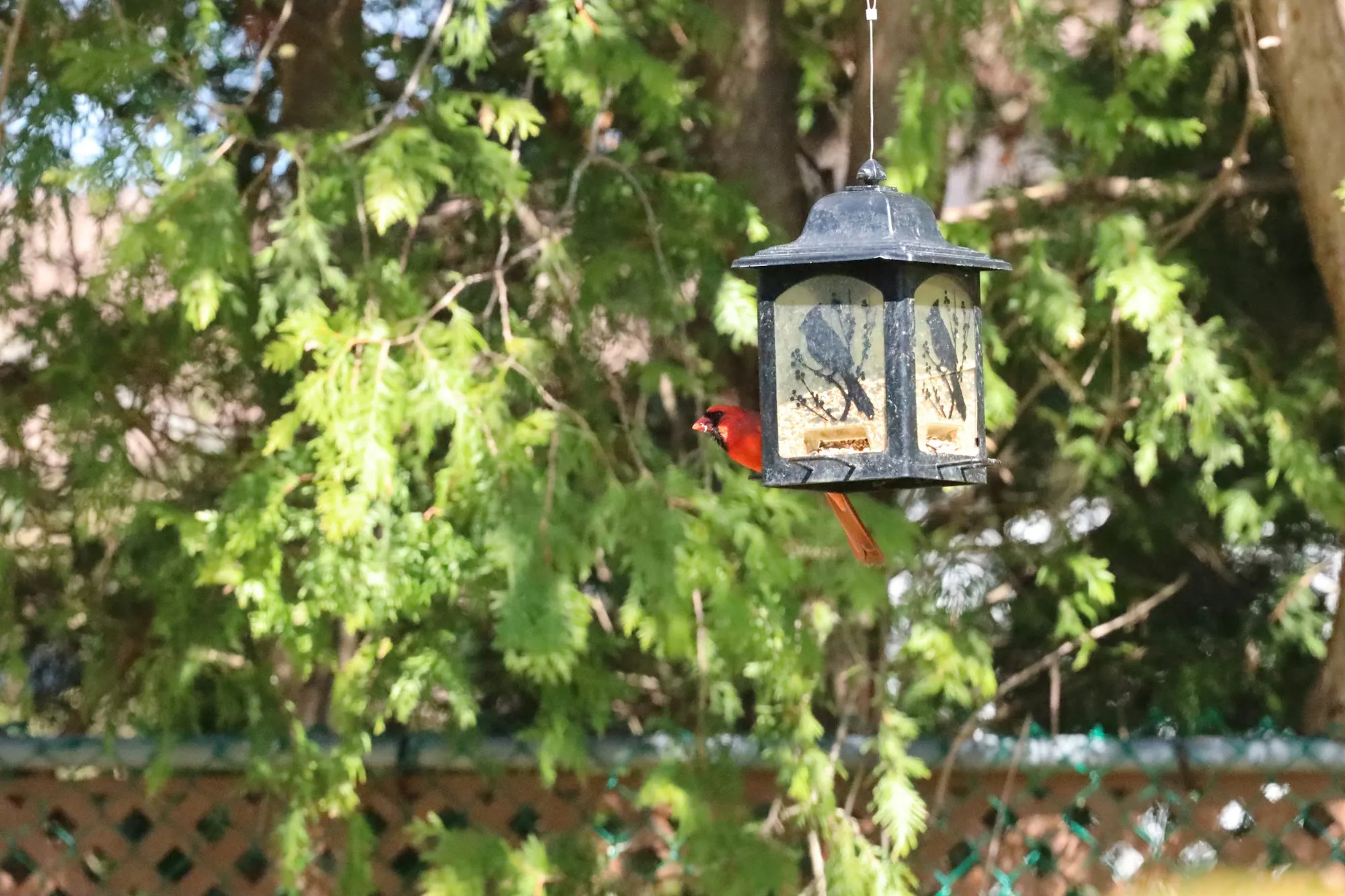
So does safflower seed keep squirrels away? It’s one of the most common squirrel tips, and it’s partly true. This page sorts the claims by where they come from, shows which birds will follow you to safflower and which pests may not leave, works out what the switch costs, and gives a switch plan that won’t empty your feeder. For the full seed lineup, see our guide to types of bird seed.
Short answer: safflower discourages many squirrels, not all
Here’s what the sources agree on:
- Gray squirrels are the ones most often said to skip it. Duncraft: “Safflower has a naturally bitter coating that most gray squirrels find unpalatable.” (Duncraft)
- Smaller raiders are less put off. The same page warns: “Note that some squirrels, particularly red squirrels and chipmunks, may still eat safflower, as individual tolerance varies.”
- Nobody promises “none.” Wild Birds Unlimited says squirrels “typically” don’t take to it (Wild Birds Unlimited). “Most” and “typically” are the strongest words in any source we could read.
So if gray squirrels are your problem, safflower is worth trying. If red squirrels or chipmunks are raiding the feeder, expect less from it.
What the sources actually say
Not every claim about safflower is equally strong. Here they are, from strongest evidence to weakest.
| Source | Type | What it says about safflower and squirrels | How strong |
|---|---|---|---|
| Geis 1980, US Fish and Wildlife Service | Controlled feeder study | Nothing. Safflower isn’t among the foods in the report, and squirrels weren’t studied | Doesn’t apply |
| National Audubon Society | Expert guidance | “You can fill any sunflower seed feeder with safflower, which many birds eat.” No squirrel claim | About birds only |
| Duncraft (retailer) | Store product FAQ | Most gray squirrels find it unpalatable; red squirrels and chipmunks may still eat it | Seller’s claim |
| Wild Birds Unlimited, Janesville (retailer) | Store page | “Many of your sunflower-eating birds love Safflower; yet blackbirds, grackles, and squirrels typically don’t.” | Seller’s claim |
Sources: Geis 1980 full text; Audubon; Duncraft; Wild Birds Unlimited Janesville.
Safflower and squirrels: how strong is each source?
Strongest kind of evidence at the top. No source here tested safflower against squirrels.
Controlled feeder study
Geis 1980, US Fish and Wildlife Service
Nothing. Safflower isn’t among the foods in the report, and squirrels weren’t studied.
How strong for the squirrel question: Doesn’t apply
Expert guidance
National Audubon Society
“You can fill any sunflower seed feeder with safflower, which many birds eat.” No squirrel claim.
How strong for the squirrel question: About birds only
Retailer: store product FAQ
Duncraft
Most gray squirrels find it unpalatable; red squirrels and chipmunks may still eat it.
How strong for the squirrel question: Seller’s claim
Retailer: store page
Wild Birds Unlimited, Janesville
Blackbirds, grackles and squirrels “typically don’t” take to it.
How strong for the squirrel question: Seller’s claim
Our reading: We found no controlled study of safflower and squirrels. The 1980 Geis study, the best-known US test of feeder foods (more than 179,000 bird visits recorded from November 1977 to July 1979, mostly near Clarksville, Maryland), didn’t include safflower. What’s left is expert guidance that doesn’t address squirrels and retailer reports that agree on “fewer squirrels, not none.” You’ll see a “study” online claiming a precise drop in squirrel visits from safflower; we couldn’t trace it to any published source, so we don’t repeat it.
Which birds eat safflower, and which pests skip it
Each row says who makes the claim. None of these is a survey result.
| Visitor | Eats safflower? | Who says so |
|---|---|---|
| Northern Cardinal | Yes, a favorite | Duncraft (“one of the best seeds for attracting cardinals”); Wild Birds Unlimited (retailers) |
| Rose-breasted Grosbeak | Yes | Duncraft (retailer) |
| Black-capped Chickadee and other chickadees | Yes | Duncraft; Wild Birds Unlimited (retailers) |
| White-breasted Nuthatch | Yes | Duncraft; Wild Birds Unlimited (retailers) |
| House Finch, Purple Finch | Yes | Duncraft; WBU names House Finches (retailers) |
| Mourning Dove | Yes | Duncraft; Wild Birds Unlimited (retailers) |
| Woodpeckers | Yes | Wild Birds Unlimited (retailer) |
| Tufted Titmouse | Not stated in the sources we could read | — |
| Gray squirrel | Most skip it | Duncraft; WBU says squirrels “typically” don’t (retailers) |
| Red squirrel, chipmunk | May still eat it | Duncraft (retailer) |
| Flying squirrels | Not stated | — |
| Common Grackle, blackbirds | Typically don’t | Wild Birds Unlimited (retailer) |
| European Starling | Typically leave it alone | Wild Birds Unlimited (retailer) |
| House Sparrow | Not stated in the sources we could read | — |
Sources: Duncraft, Wild Birds Unlimited Janesville (read October 30, 2026).
| Visitor (who says so) | Eats safflower? |
|---|---|
| Northern CardinalDuncraft; WBU | Yes, a favorite |
| Rose-breasted GrosbeakDuncraft | Yes |
| ChickadeesDuncraft; WBU | Yes |
| White-breasted NuthatchDuncraft; WBU | Yes |
| House Finch, Purple FinchDuncraft; WBU (House Finch) | Yes |
| Mourning DoveDuncraft; WBU | Yes |
| WoodpeckersWBU | Yes |
| Tufted Titmouse | Not stated |
| Gray squirrelDuncraft; WBU | Most skip it |
| Red squirrel, chipmunkDuncraft | May still eat it |
| Flying squirrels | Not stated |
| Common Grackle, blackbirdsWBU | Typically don’t |
| European StarlingWBU | Typically leave it alone |
| House Sparrow | Not stated |
Cardinals are the reason most people try safflower, and they’re the bird you’re least likely to lose. Our guide on how to attract cardinals covers the rest of what they need.
What safflower costs vs sunflower
All prices from Duncraft on October 30, 2026, 5-lb bags, all available to order (from Duncraft’s store data for safflower, black-oil sunflower, sunflower hearts and NutraSaff):
| Seed (Duncraft, 5 lb) | Price | Per pound | vs black-oil sunflower |
|---|---|---|---|
| Black-oil sunflower | $18.95 | $3.79 | — |
| NutraSaff (safflower grown without the hard outer shell) | $23.95 | $4.79 | +26% |
| Safflower | $24.95 | $4.99 | +32% |
| Whole sunflower hearts | $29.95 | $5.99 | +58% |
What that means in a season: for every 20 pounds of seed you go through, safflower costs about $24 more than black-oil sunflower at these prices ($99.80 vs $75.80). Duncraft sold plain safflower only in 5-lb bags when we checked, so we can’t compare bulk prices at the same store. Audubon suggests looking for safflower “in bulk at seed and feed stores.”
One option: Duncraft Safflower, 5-lb (opens in a new tab), $24.95, available to order on October 30, 2026. For the black-oil sunflower it replaces, see our types of bird seed guide.
NutraSaff, per Duncraft, “has been cultivated without the hard outer shell,” and the store says “most squirrels dislike the bitter taste” of it too (Duncraft). That’s another seller’s claim, not a test result.
How to switch to safflower without losing your birds
Mix first or go straight?
The two retailers agree on phasing it in, with one caveat from Duncraft.
- To keep your birds: Wild Birds Unlimited says to “Offer safflower gradually, mixing it with the seed blends you currently provide” (Wild Birds Unlimited). Duncraft suggests mixing safflower into your current sunflower and gradually cutting back the sunflower over 1 to 2 weeks, until you’re serving pure safflower.
- To stop squirrels fastest: Duncraft says, “For the fastest squirrel deterrence, serve pure safflower from the start rather than blending.” (Duncraft)
Our suggestion: if squirrels are emptying the feeder every day, go straight to safflower and accept a slower week at the feeder. If they’re a nuisance rather than a crisis, phase it in over 1 to 2 weeks. Either way, finish on straight safflower. Any sunflower left in the mix is still squirrel food.
Feeders that work for safflower
You probably don’t need new equipment. Wild Birds Unlimited says safflower can be offered in hopper, platform or tube feeders, and Duncraft adds tray feeders. WBU also calls it “especially helpful for window or deck feeders” where blackbirds or squirrels are a problem.
Keep it off wet ground. Audubon passes on advice to avoid putting safflower on the ground in wet weather, because it “can quickly become soggy and inedible” (Audubon). A tray under the feeder catches spill.
A safflower-only station
If you also feed sunflower, keep the two feeders apart. This is our suggestion, not a tested setup: put the safflower feeder in the spot squirrels reach most easily, and move the sunflower feeder to the most squirrel-proof spot, on a baffled pole at least 10 feet from jump-off points. Our guide to where to put a bird feeder covers cover, window distance and jump zones.
Give birds time
Birds that are used to sunflower may ignore a new seed at first. Duncraft says birds “may take a few days to adjust to a new seed, especially if they’re used to a blend,” and its phase-in runs 1 to 2 weeks (Duncraft). No source we read gives a firmer number. Don’t judge the switch by the first few days, and keep the feeder clean and full while they adjust.
When safflower isn’t enough
Safflower changes what’s in the feeder, not who can reach it. Expect it to fall short when:
- Red squirrels or chipmunks are the raiders. Duncraft says they may still eat it.
- Your squirrels are the tolerant kind. Duncraft’s own wording is “individual tolerance varies.”
- Food is short. Hungry squirrels are less picky. This is our reasoning, not a sourced finding, but plan for a tougher late winter.
- Seed piles up on the ground, which keeps squirrels and chipmunks checking under the feeder.
Then layer it with access control, which does most of the work:
- Placement: at least 10 feet from trees, fences and roofs. See how to keep squirrels off a bird feeder for all seven methods, ranked.
- A baffle: see how to install a squirrel baffle.
- A proper pole: our squirrel-proof bird feeder pole picks.
- A weight-activated feeder: our squirrel-proof bird feeders guide. One example is the Brome Squirrel Buster Standard (opens in a new tab) ($59.95 at Brome, October 30, 2026). Brome itself says the feeder will not deter juvenile red, Douglas or flying squirrels, or chipmunks, the same small raiders safflower may not stop (Brome).
Safflower vs hot-pepper seed
Hot-pepper (capsaicin) seed is the other “squirrels won’t eat it” option. The evidence on it is thinner than the labels suggest, and our squirrel guide sets out what’s known. Safflower is a plain seed with no additives, which is one reason many people try it first.
Feeding through the winter
Safflower is a fine winter seed for cardinals, chickadees and nuthatches, but it shouldn’t be your only food when it’s cold. Our guide to what to feed birds in winter covers suet, millet and open water.
Related
- Types of bird seed
- How to keep squirrels off a bird feeder
- Best squirrel-proof bird feeders
- How to attract cardinals
Sources
- National Audubon Society: Top 10 foods for winter bird feeding (read October 30, 2026)
- Aelred D. Geis, Relative Attractiveness of Different Foods at Wild Bird Feeders, US Fish and Wildlife Service Special Scientific Report–Wildlife No. 233, 1980: full text (Internet Archive) (read October 30, 2026)
- Retailers: Duncraft Safflower 5-lb, Duncraft NutraSaff 5-lb, Duncraft Black Oil Sunflower 5-lb, Duncraft Whole Sunflower Hearts 5-lb, Wild Birds Unlimited Janesville, The Safflower Solution (all read October 30, 2026)
- Manufacturer: Brome Squirrel Buster Standard (store data read October 30, 2026)
Frequently asked questions
- Do squirrels eat safflower seed?
- Some do. Duncraft says most gray squirrels find safflower's bitter coating unpalatable, but that some squirrels, particularly red squirrels and chipmunks, may still eat it, 'as individual tolerance varies.' Wild Birds Unlimited says squirrels 'typically' don't take to it. We found no controlled study either way.
- Which birds eat safflower?
- Northern Cardinals are its best-known fans. Duncraft also lists Rose-breasted Grosbeaks, Black-capped Chickadees, Mourning Doves, House Finches, Purple Finches and White-breasted Nuthatches, and a Wild Birds Unlimited store adds woodpeckers. These are retailer lists, not survey results.
- Should I mix safflower with other seed?
- It depends on what matters more to you. Duncraft suggests mixing safflower into your current sunflower and cutting the sunflower back over 1 to 2 weeks so birds get used to it, but says pure safflower from the start deters squirrels fastest. Either way, finish on straight safflower, since sunflower in the mix still draws squirrels.
- Is safflower more expensive than sunflower?
- Yes. At Duncraft on October 30, 2026, a 5-lb bag of safflower was $24.95 ($4.99 per pound) and a 5-lb bag of black-oil sunflower was $18.95 ($3.79 per pound), so safflower cost about 32% more per pound.
- Does safflower keep grackles and starlings away?
- Retailers say so. A Wild Birds Unlimited store page says blackbirds, grackles and squirrels typically don't take to safflower, and that squirrels, grackles and starlings will typically leave it alone. That's a seller's claim, not a study. None of the sources we could read covers House Sparrows.
- How long before birds eat safflower?
- Duncraft says birds may take a few days to adjust to a new seed, especially if they're used to a blend, and its phase-in plan runs 1 to 2 weeks. No source we read gives a firmer number, so expect a quieter feeder for a while after you switch.
Keep reading

Written by
Research and editing
The Feeder Field editorial team researches backyard birding gear and bird feeding for US readers. We compare manufacturer specifications, subscription terms and long-term owner feedback, and we check feeding and bird-behavior advice against the Cornell Lab of Ornithology, Audubon and university extension services. Articles are drafted with the help of AI tools, then fact-checked and edited by our team before they go live. Every guide says whether it is researched or hands-on tested, and we update buying guides at least every six months.