Guide
How to Clean a Bird Feeder (and How Often)
Clean seed feeders about every 2 weeks: scrub, soak in 1 part bleach to 9 parts water (10 minutes in most guidance), rinse, dry. What US agencies say.
Updated
Disclosure: We may earn a commission when you buy through links on this page. Read our affiliate disclosure.
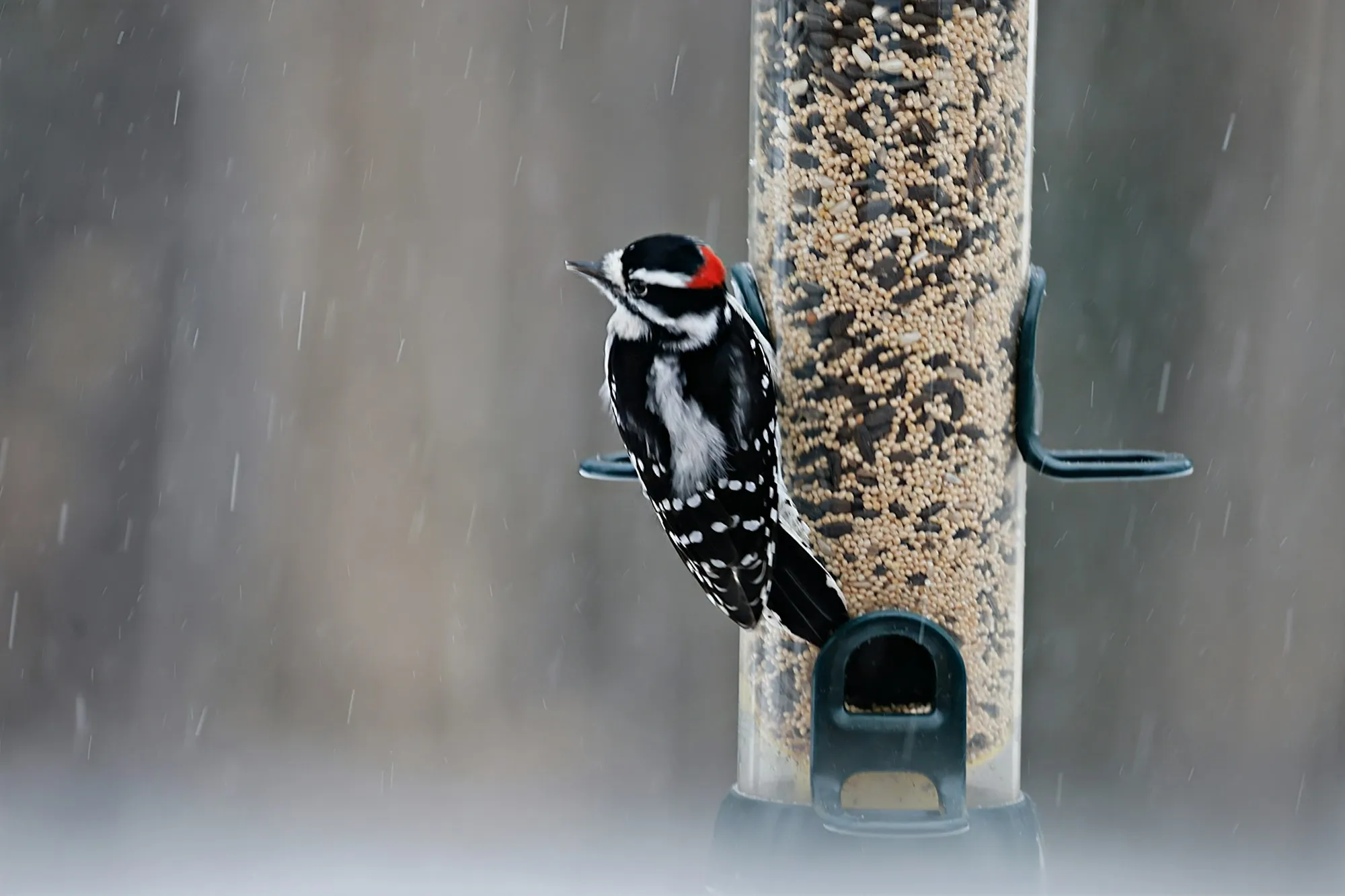
This page gives you the steps, the ratio and the timing, and shows where the authorities disagree. They agree on the bleach ratio. They don’t agree on soak time, how often to clean, or vinegar.
Health note: Salmonella from birds can make people sick. The safety steps below are quoted from the CDC and state agencies. For medical questions, ask a doctor.
How often should you clean a bird feeder?
About every two weeks for a seed feeder, with more frequent cleaning when needed:
- The U.S. Fish and Wildlife Service says to wash and clean feeders “once every 2 weeks, or more often if they are heavily used, if there’s been wet weather, or if you notice sick birds or hear reports of disease outbreaks (like salmonella) in your area” (USFWS).
- Clemson’s Home & Garden Information Center says: “Seed feeders should be cleaned at least every two weeks, more often when there are a lot of visitors or rain” (Clemson HGIC). An NC State Extension county page reposts the same Clemson article. West Virginia DNR says “preferably every other week” (WV DNR).
- Some sources ask for more. In August 2021, after sick and dead songbirds were reported in 10 states including Pennsylvania, plus Washington, D.C., the Pennsylvania Game Commission advised cleaning “at a minimum weekly basis” (The Allegheny Front). During a 2021 Salmonella outbreak, the CDC said: “Clean and disinfect your bird feeder and bird bath weekly or when they are visibly dirty” (CDC).
- One source asks for less: University of Maine Cooperative Extension’s bulletin (revised 2003) says to clean and disinfect feeders “once or twice a month,” and more often if you see sick birds (UMaine bulletin #7145).
Wet weather matters because wet seed spoils. If you feed through a rainy fall or a snowy winter, our guide on what to feed birds in winter covers keeping seed dry.
What you need
- Rubber or disposable gloves
- A bucket or tub you use only for feeders (not the kitchen sink)
- Household bleach
- A bottle brush and a scrub brush, kept for feeder cleaning only
- A timer
- A spot in the sun, or a rack, for drying
- A trash bag for old seed
West Virginia DNR advises wearing gloves and keeping a brush just for feeder cleaning so you don’t spread disease (WV DNR). Arkansas Game and Fish also recommends “wearing rubber gloves when cleaning feeders” (AGFC).
How to clean a bird feeder in 7 steps
7 steps, about every two weeks
1Gloves on, outdoors
Clean outside the house when possible (CDC).
2Empty it
Bin old seed in the household trash.
3Take it apart
Base, perches, ports and lid.
4Scrub
Hot soapy water and brushes; rinse off the soap.
5Soak 1:9
1 part bleach to 9 parts water, 10 minutes (USFWS, Clemson).
6Rinse
Until you can’t smell bleach.
7Dry completely
Ideally in the sun, before refilling.
1. Put on gloves and work outdoors
The CDC says: “Feeders should be cleaned outside your house when possible.” If you have to clean indoors, it says to “use a laundry sink or bathtub, and thoroughly clean and disinfect the area right after.” It also says: “Always wash your hands right after touching a bird feeder, bird bath, or after handling a bird – even if you wore gloves.” And: “Keep pets away from bird feeders and bird baths and the areas under them” (CDC).
2. Empty it and bin the old seed
Throw out leftover seed in the household trash. University of Maine Cooperative Extension says to discard food that smells musty, is wet, looks moldy or has fungus on it, or has had rodents in it, and to disinfect the storage container and scoop if they touched spoiled food (UMaine). (That PDF is UMaine bulletin #7145, hosted on a University of California site.)
3. Take it apart
Remove the base, perches, ports and lid if they come off. The USFWS steps start with “Take the feeder apart and remove any leftover seeds” (USFWS).
4. Scrub off all debris
Use hot soapy water and your brushes. Get into the ports, the seed tray and the inside of the tube. Clemson says to “remove any debris from the feeder by first scrubbing each part with a sponge or brush” (Clemson HGIC). UMaine’s instructions also put “an empty, cleaned feeder” into the bleach, and its nectar-feeder section explains why: washing before bleaching keeps organic material out of the solution (UMaine). Rinse the soap off before you disinfect.
5. Disinfect: 1 part bleach to 9 parts water
Mix 1 cup of household bleach with 9 cups of water (or 100 ml with 900 ml). Submerge every part, and set a timer for 10 minutes.
1 part bleach + 9 parts water
- In cups
- 1 cup bleach + 9 cups water
- In milliliters
- 100 ml bleach + 900 ml water
- Soak
- 10 minutes (USFWS, Clemson), then rinse until you can’t smell bleach
- USFWS: “You can also soak bird feeders in a solution of diluted bleach (1 part bleach to 9 parts water) for 10 minutes.” It lists a hot-water dishwasher, or hand-washing with soap and boiling water, as the other options.
- Clemson: “Research shows that 10% bleach (1 part bleach to 9 parts water) is the most effective method to get rid of salmonella.” It says to “Soak each section of the feeder in a diluted bleach solution or hydrogen peroxide for 10 minutes” (Clemson HGIC).
Other sources use shorter or longer soak times; see the table below.
6. Rinse thoroughly
Rinse every part in clean water until you can’t smell bleach. Clemson says: “If you use bleach to clean the feeder, make sure to rinse off all residue before refilling it.” That line sits in its hummingbird section, but it applies to any feeder. UMaine’s nectar-feeder section warns: “Soap or bleach residue in the feeder will harm birds.”
7. Dry completely before refilling
Air-dry every part, ideally in the sun, before you put it back together. Clemson’s seed-feeder section says to “rinse all parts of the feeder and allow it to dry completely before refilling the feeder.” Wet seed in a damp tube spoils fast.
Bleach, vinegar or soap? What the sources say
| Source | How often | Ratio | Soak / contact time | Other notes |
|---|---|---|---|---|
| U.S. Fish and Wildlife Service (Youth Fish and Wildlife Club handout, Jan 2025) | Every 2 weeks, more if busy, wet or sick birds | 1:9 | 10 min | Bleach soak is one option; dishwasher with hot water, or soap and boiling water, also listed |
| Clemson HGIC (Feb 2025), reposted by NC State Extension | At least every 2 weeks | 1:9 (10%) | 10 min | Bleach or hydrogen peroxide; soap “not as thoroughly” |
| Pennsylvania Game Commission (Aug 2021, via The Allegheny Front) | At least weekly | 10% | 10 min contact | Soap and water first; issued after the 2021 songbird illness |
| University of Maine Cooperative Extension (bulletin #7145, rev. 2003) | Once or twice a month; more with sick birds | 1:9, warm water | 2–3 min | No vinegar |
| West Virginia DNR (undated) | Preferably every other week | 1:9 | Half an hour (“many experts recommend”) | Gloves; separate brush; dishwasher on high heat is an option |
| CDC (2021 Salmonella outbreak) | Weekly or when visibly dirty | Not given | Not given | Clean outdoors; wash hands |
| Brome Bird Care (maker) | Every 2–3 weeks in its FAQ; every 2 weeks in its steps | 1:10 in its FAQ; 1:9 in its steps | At least 15 min | Bleach wipes between washings |
| Bird Buddy (maker) | At least once a month | “10% bleach solution” | Not given | Avoid harsh chemicals with scratchy sponges |
Where they agree: 1 part bleach to 9 parts water (only Brome’s FAQ says 1:10), a scrub before the soak, a thorough rinse and full drying.
Where they don’t:
- Soak time ranges from 2–3 minutes (UMaine) to 10 minutes (USFWS, Clemson, Pennsylvania), at least 15 minutes (Brome, for its own feeders) and half an hour (West Virginia DNR, which attributes it to “many experts”). Ten minutes is what most of the government and extension sources say. None of them explains why its time differs from the others, and none cites a study comparing soak times. For a Brome feeder, follow Brome.
- Frequency ranges from weekly (Pennsylvania and CDC, both 2021, both during a songbird disease event) to once or twice a month (UMaine, 2003) and once a month (Bird Buddy, for its own feeder). Every two weeks is the most common baseline. Go weekly when the feeder is busy, the weather is wet, or there’s a disease report in your area.
- Vinegar. UMaine says: “Do not use vinegar as a substitute for bleach because it does not destroy bacteria, mold or yeast.” Clemson suggests a 4-to-1 vinegar and water wash once a week for hummingbird feeders when no mold is present. No source we read recommends vinegar in place of bleach for seed feeders.
- Soap alone. Clemson: “Soap and water will also clean the feeders, although not as thoroughly as using bleach.” USFWS lists soap and boiling water as an option alongside the bleach soak.
Our synthesis (not a new rule): scrub first, soak in 1:9 bleach for 10 minutes, rinse until the smell is gone, dry completely, every two weeks or more often when needed. That meets or exceeds USFWS, Clemson, Pennsylvania and UMaine. It’s shorter than West Virginia DNR’s half hour and Brome’s 15 minutes for its own feeders. If you want to cover every source, soak for 30 minutes; we found no source saying a longer soak harms a plastic or metal feeder, but we also found none testing it.
Cleaning by feeder type
| Feeder type | What to focus on | Notes |
|---|---|---|
| Tube | Ports and perches; bottom of the tube where seed packs | A long bottle brush reaches the inside |
| Hopper | Seed tray and the gap under the hopper walls | Wet seed collects in the tray |
| Tray / platform | The whole surface, often | Birds stand in the food. The Canadian Wildlife Health Cooperative advises against table feeders, and Arkansas Game and Fish suggests feeders without platforms or wide perches (see below) |
| Wooden | Scrub, rinse, long dry | Arkansas Game and Fish says wooden feeders “can also increase the risk of disease transmission”; dry fully in the sun |
| Suet cage | Old suet residue | Hot soapy water and a stiff brush |
| Mesh / peanut | Mesh openings | A brush through the mesh; check for moldy nuts |
| Window | Suction cups and tray | Easy to reach, so clean often |
| Smart camera feeder | Seed bin and tray, not the camera | Remove the camera first; follow the maker |
The suet, mesh and window notes are our practical suggestions. We found no agency guidance specific to those types.
Where to focus, by feeder type
Tube
Ports, perches, and the bottom where seed packs.
Hopper
Seed tray and the gap under the walls.
Tray / platform
The whole surface, often. Birds stand in the food.
Wooden
Scrub, rinse, then a long dry in the sun.
Suet cage
Old suet residue: hot soapy water, stiff brush.
Mesh / peanut
Brush the mesh; check for moldy nuts.
Window
Suction cups and tray. Easy to reach, so clean often.
Smart camera
Seed bin and tray. Remove the camera first.
Cleaning popular feeders
Brome Squirrel Buster. Brome says its feeders “are designed to be dismantled by hand into individual components without the use of tools” (Brome). Its cleaning page says to soak for at least 15 minutes in bleach solution, then wash in warm soapy water, rinse in tepid water and air-dry completely. The same page gives the frequency as both every 2 to 3 weeks and every 2 weeks, and the ratio as both 1:10 and 1:9. The two ratios are close; 1:9 matches the agencies above. If you’re choosing a new feeder, see our squirrel-proof feeders that come apart without tools. The Brome Squirrel Buster Plus (opens in a new tab) is $129.25 on Brome’s US store as of October 8, 2026.
Bird Buddy. Bird Buddy’s own cleaning post says you can wipe grime off with “a wet cloth or a sponge,” flush the feeder through the drainage holes “with a jet of water,” and scrub the seed container with “a bottle brush.” It warns against “harsh chemicals in combination with scratchy sponges,” says “any commercially available 10% bleach solution will work fine,” and says: “At the very least, we recommend you clean your feeder once a month.” The post doesn’t cover the camera. Our practical suggestion: take it out before any wet cleaning.
Birdfy Feeder 2 series. Birdfy’s care page says to “Take off the perch,” “Unscrew the main camera,” open the roof to 80° to detach it, remove the inner roof, seed guard and front panel, and “Use a brush and water to clean the feeder body and the components.” The page doesn’t mention bleach. If you disinfect, do it with the camera removed and rinse well.
More on these feeders: our smart bird feeder rankings and bird feeder cameras without a subscription.
If you see sick birds
UMaine says sick birds may have unkempt feathers or look puffed up, and are less alert, less active, feed less, and are often reluctant to fly away as you approach (UMaine). What to do:
- Take feeders and baths down for at least two weeks. The CDC said in 2021: “If you find a sick or dead bird in your yard, remove any bird feeders and baths for two weeks and clean them outdoors.” Arkansas Game and Fish says to “remove the feeder for at least two weeks” and disinfect it with bleach and water before refilling (AGFC).
- Report it. The CDC says: “If you find a sick or dead bird, call your state wildlife agency or wildlife rehabilitator.” Don’t handle wild birds with bare hands.
- Clean more often after you restart. USFWS says to clean more often if you see sick birds.
Why the type of disease changes what you clean:
| How it spreads | Disease | What to focus on |
|---|---|---|
| Contact with feeder surfaces | House Finch eye disease (mycoplasmal conjunctivitis). Arkansas Game and Fish says the bacteria “spread from bird-to-bird through contact with feeders” and other surfaces infected birds have touched. | Ports and perches, where birds’ heads and eyes touch |
| Contaminated food and water | Trichomonosis. The Canadian Wildlife Health Cooperative says it spreads “through food or water contaminated with recently regurgitated saliva or droppings” (CWHC). | Trays, platforms and baths; keep seed dry |
| Contaminated food and water | Salmonellosis. UMaine lists “food and water contaminated by mold, fungus and infected feces” among the causes of the five feeder diseases it names. | Trays and the ground under the feeder |
How it spreads, and what to clean
Contact with feeder surfaces
- Example
- House Finch eye disease (Arkansas Game and Fish)
- Focus on
- Ports and perches, where heads and eyes touch
Contaminated food and water
- Example
- Trichomonosis (CWHC)
- Focus on
- Trays, platforms and baths; keep seed dry
Contaminated food and water
- Example
- Salmonellosis (UMaine)
- Focus on
- Trays and the ground under the feeder
The “what to focus on” column is our reading of those sources. The CWHC also says: “Only use bird feeders that prevent the seed from getting wet,” and advises against table feeders because they don’t keep food dry. During a known trichomonosis outbreak, it says “bird feeders and artificial water sources should remain out of use until the end of the known transmission period.” The CWHC is a Canadian body. In the US, follow your state wildlife agency.
For other reasons to take feeders down (bears, hawks and local rules), see where to put a bird feeder.
Clean under the feeder too
- Clear the ground. UMaine says to clean up waste food and droppings from the ground “every few days,” and if you suspect disease, to rake the area and cover it with a tarp for one to two weeks. USFWS says to clean the ground below feeders to prevent a buildup of moldy or spoiled food and droppings and to avoid attracting rodents.
- Avoid crowding. UMaine recommends enough feeders that birds don’t crowd, and moving a feeder a short distance regularly so contaminated seed and droppings don’t build up in one spot. Arkansas Game and Fish warns that “it only takes one that has a disease to spread it to many others.”
- Store seed dry. Discard anything wet, musty, moldy or chewed by rodents (UMaine). Our types of bird seed guide covers the common seeds.
Don’t forget the bird bath
Baths spread disease too, and the CDC’s 2021 advice covers feeders and baths together. UMaine suggests rinsing baths and replacing the water every day. Our guides to keeping a bird bath from freezing and heated bird baths cover winter water.
Related
Sources
- U.S. Fish and Wildlife Service, Backyard Birds feeding tips (Jan 29, 2025)
- Clemson HGIC, Washing Bird Feeders (Feb 20, 2025); NC State Extension, McDowell County, Washing Bird Feeders
- University of Maine Cooperative Extension, Keeping Your Yard Safe for Birds, bulletin #7145 (rev. March 2003)
- West Virginia DNR, winter bird feeder care tips
- CDC, 2021 Salmonella outbreak linked to wild songbirds
- The Allegheny Front, Pennsylvania Game Commission guidance (Aug 13, 2021)
- Arkansas Game and Fish Commission, keep feeders clean (Jan 23, 2019)
- Canadian Wildlife Health Cooperative, trichomonosis
- Makers: Brome, cleaning your feeder, Brome Squirrel Buster Plus, Bird Buddy, cleaning post, Birdfy Feeder 2 series care
Frequently asked questions
- How often should you clean a bird feeder?
- About every two weeks for seed feeders, according to the U.S. Fish and Wildlife Service, Clemson extension and West Virginia DNR. Clean more often when the feeder is busy, after wet weather, or if you see sick birds. Some agencies go further: the Pennsylvania Game Commission advised at least weekly cleaning in 2021, and the CDC advised weekly cleaning during a 2021 Salmonella outbreak. University of Maine Extension's older bulletin says once or twice a month.
- What is the bleach-to-water ratio for cleaning bird feeders?
- 1 part household bleach to 9 parts water, a 10% solution. That ratio appears in guidance from the U.S. Fish and Wildlife Service, Clemson extension, West Virginia DNR and University of Maine Cooperative Extension. Soak times differ: USFWS and Clemson say 10 minutes, UMaine says 2 to 3 minutes, and West Virginia DNR says many experts recommend half an hour.
- Can I clean a bird feeder with vinegar?
- Sources disagree. University of Maine Cooperative Extension says not to use vinegar as a substitute for bleach because it does not destroy bacteria, mold or yeast. Clemson extension suggests a 4-to-1 vinegar and water wash once a week for hummingbird feeders when no mold is present. No source we read recommends vinegar instead of bleach for seed feeders.
- Can I put a bird feeder in the dishwasher?
- The U.S. Fish and Wildlife Service lists a dishwasher with hot water as one cleaning option, and West Virginia DNR suggests a high-heat setting. Only do it if the maker says the parts are dishwasher-safe, and never put a smart feeder's camera in the dishwasher.
- Should I take my feeders down if I see a sick bird?
- Yes. During a 2021 Salmonella outbreak, the CDC advised removing feeders and baths for two weeks if you find a sick or dead bird in your yard, and cleaning them outdoors. Arkansas Game and Fish also recommends removing the feeder for at least two weeks. Follow your state wildlife agency's current advice.
- How do I clean a wooden bird feeder?
- Arkansas Game and Fish warns that wooden feeders can increase the risk of disease transmission, so if you're buying new, pick plastic or metal. For a wooden feeder you already own, follow the maker's instructions: scrub with hot soapy water, rinse well, and let it dry fully in the sun before refilling, since wood holds moisture.
Keep reading

Written by
Research and editing
The Feeder Field editorial team researches backyard birding gear and bird feeding for US readers. We compare manufacturer specifications, subscription terms and long-term owner feedback, and we check feeding and bird-behavior advice against the Cornell Lab of Ornithology, Audubon and university extension services. Articles are drafted with the help of AI tools, then fact-checked and edited by our team before they go live. Every guide says whether it is researched or hands-on tested, and we update buying guides at least every six months.