Guide
How to Attract Woodpeckers: Food, Feeders, Trees and Nest Boxes
How to attract woodpeckers: suet in winter, peanuts year-round, a feeder near a trunk, safe dead wood and the right nest box. With odds by state. Sourced.
Updated
Disclosure: We may earn a commission when you buy through links on this page. Read our affiliate disclosure.
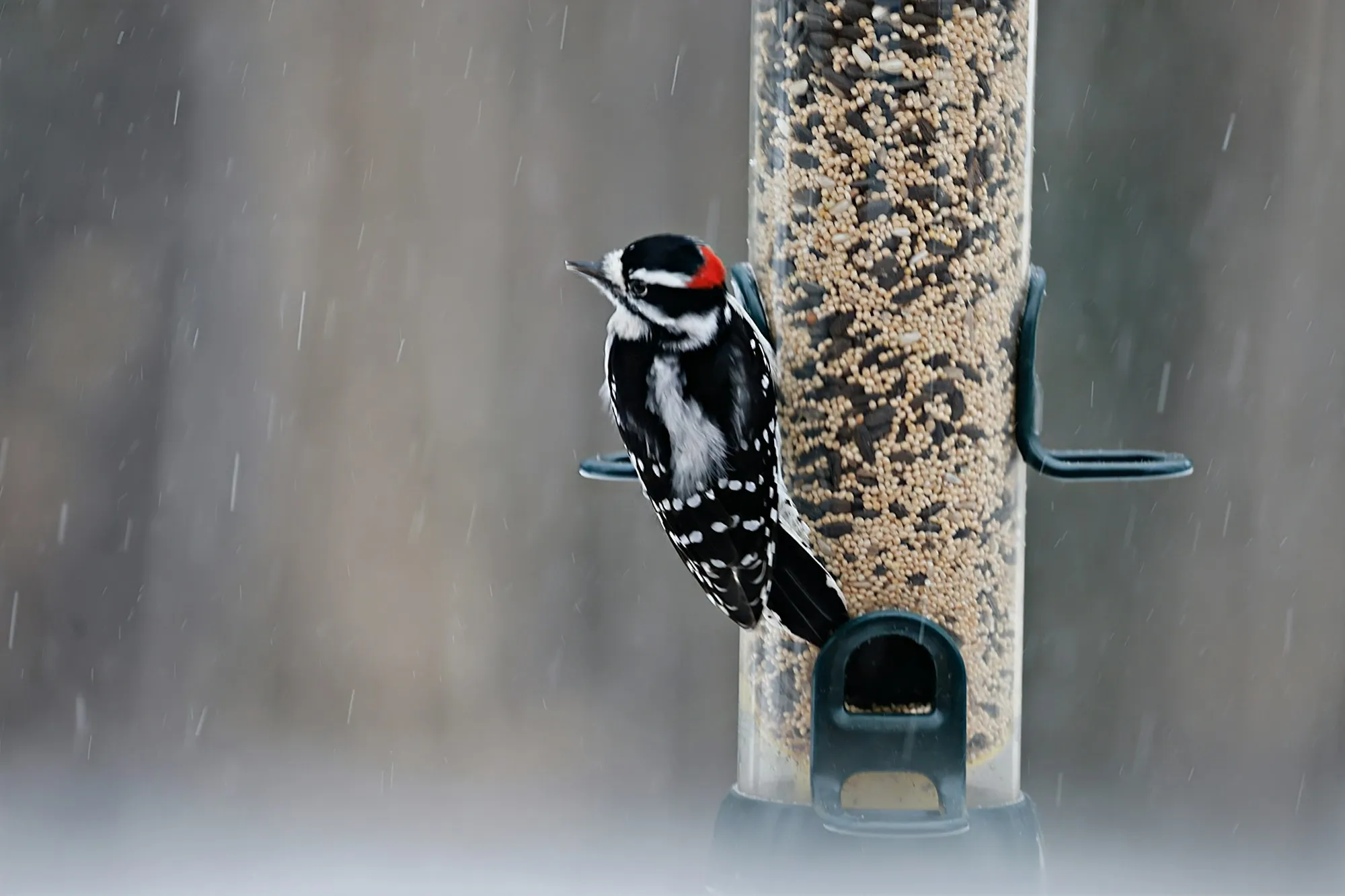
Learning how to attract woodpeckers starts with knowing which ones live near you. In most of the East and Midwest, a Downy Woodpecker at a suet feeder is close to a sure thing. A Pileated is a long shot unless you live near big trees. This guide covers the odds by state, what each woodpecker eats, which feeders they can use and where to hang them. It also covers dead wood, nest box sizes and keeping woodpeckers off your siding.
Which woodpeckers can you attract?
The best data on which woodpeckers come to feeders is Project FeederWatch, the Cornell Lab’s count of feeder birds. The table shows the share of FeederWatch sites each woodpecker visited in the 2024–25 season. The column name is FeederWatch’s own: “Percentage of Sites Visited.”
| State (FeederWatchers) | Downy | Hairy | Red-bellied | Northern Flicker | Pileated |
|---|---|---|---|---|---|
| Michigan (585) | 90.44% | 64.02% | 83.47% | 41.65% | 31.12% |
| Minnesota (474) | 89.60% | 75.00% | 78.20% | 36.80% | 45.00% |
| Ohio (670) | 89.57% | 60.64% | 84.01% | 48.12% | — |
| Pennsylvania (971) | 87.45% | 60.04% | 82.63% | 39.38% | — |
| New York (1,312) | 87.10% | 66.01% | 80.29% | — | — |
| Virginia (946) | 84.88% | 38.64% | 82.78% | 41.84% | — |
| Georgia (273) | 81.51% | — | 75.00% | — | — |
| Texas (700) | 45.89% | — | 46.68% | — | — |
| Colorado (466) | 65.42% | 30.84% | — | 78.39% | — |
| Washington (523) | 51.71% | 26.85% | — | 75.50% | — |
Source: Project FeederWatch Top 25 Feeder Birds, 2024–25, per state: MI, MN, OH, PA, NY, VA, GA, TX, CO, WA. Read October 11, 2026.
Which woodpeckers visit feeders in your state?
Percentage of Sites Visited, Project FeederWatch 2024–25
Michigan (585 FeederWatchers)
- Downy
- 90.44%
- Hairy
- 64.02%
- Red-bellied
- 83.47%
- Flicker
- 41.65%
- Pileated
- 31.12%
Minnesota (474 FeederWatchers)
- Downy
- 89.60%
- Hairy
- 75.00%
- Red-bellied
- 78.20%
- Flicker
- 36.80%
- Pileated
- 45.00%
Ohio (670 FeederWatchers)
- Downy
- 89.57%
- Hairy
- 60.64%
- Red-bellied
- 84.01%
- Flicker
- 48.12%
- Pileated
- not in top 25
Pennsylvania (971 FeederWatchers)
- Downy
- 87.45%
- Hairy
- 60.04%
- Red-bellied
- 82.63%
- Flicker
- 39.38%
- Pileated
- not in top 25
New York (1,312 FeederWatchers)
- Downy
- 87.10%
- Hairy
- 66.01%
- Red-bellied
- 80.29%
- Flicker
- not in top 25
- Pileated
- not in top 25
Virginia (946 FeederWatchers)
- Downy
- 84.88%
- Hairy
- 38.64%
- Red-bellied
- 82.78%
- Flicker
- 41.84%
- Pileated
- not in top 25
Georgia (273 FeederWatchers)
- Downy
- 81.51%
- Hairy
- not in top 25
- Red-bellied
- 75.00%
- Flicker
- not in top 25
- Pileated
- not in top 25
Texas (700 FeederWatchers)
- Downy
- 45.89%
- Hairy
- not in top 25
- Red-bellied
- 46.68%
- Flicker
- not in top 25
- Pileated
- not in top 25
Colorado (466 FeederWatchers)
- Downy
- 65.42%
- Hairy
- 30.84%
- Red-bellied
- not in top 25
- Flicker
- 78.39%
- Pileated
- not in top 25
Washington (523 FeederWatchers)
- Downy
- 51.71%
- Hairy
- 26.85%
- Red-bellied
- not in top 25
- Flicker
- 75.50%
- Pileated
- not in top 25
How to read it:
- “—” means the bird wasn’t in that state’s top 25 feeder birds. It may still visit, just at fewer sites.
- In California, the only woodpecker in the top 25 was Nuttall’s Woodpecker, at 33.12% of 722 sites (CA).
- In the West, the flicker is the woodpecker you’re most likely to see. In Colorado and Washington, it outranked the Downy.
- These are counts at feeders, so woodpeckers that rarely use feeders or leave for the winter are undercounted. Audubon calls the Yellow-bellied Sapsucker “one of the most migratory of woodpeckers,” with “essentially no overlap between its summer and winter ranges.” It isn’t in the top 25 for any state above.
To check a species for your area, use the range map on its Audubon field guide page (links under the menu table below).
Downy vs Hairy: the 5-second ID
They look almost identical. The bill is the tell.
- Downy: small, 5–7 inches long, with a “very short, stubby bill” (Audubon).
- Hairy: 7.1–10.2 inches long, with “a bill nearly as long as its head” (Audubon).
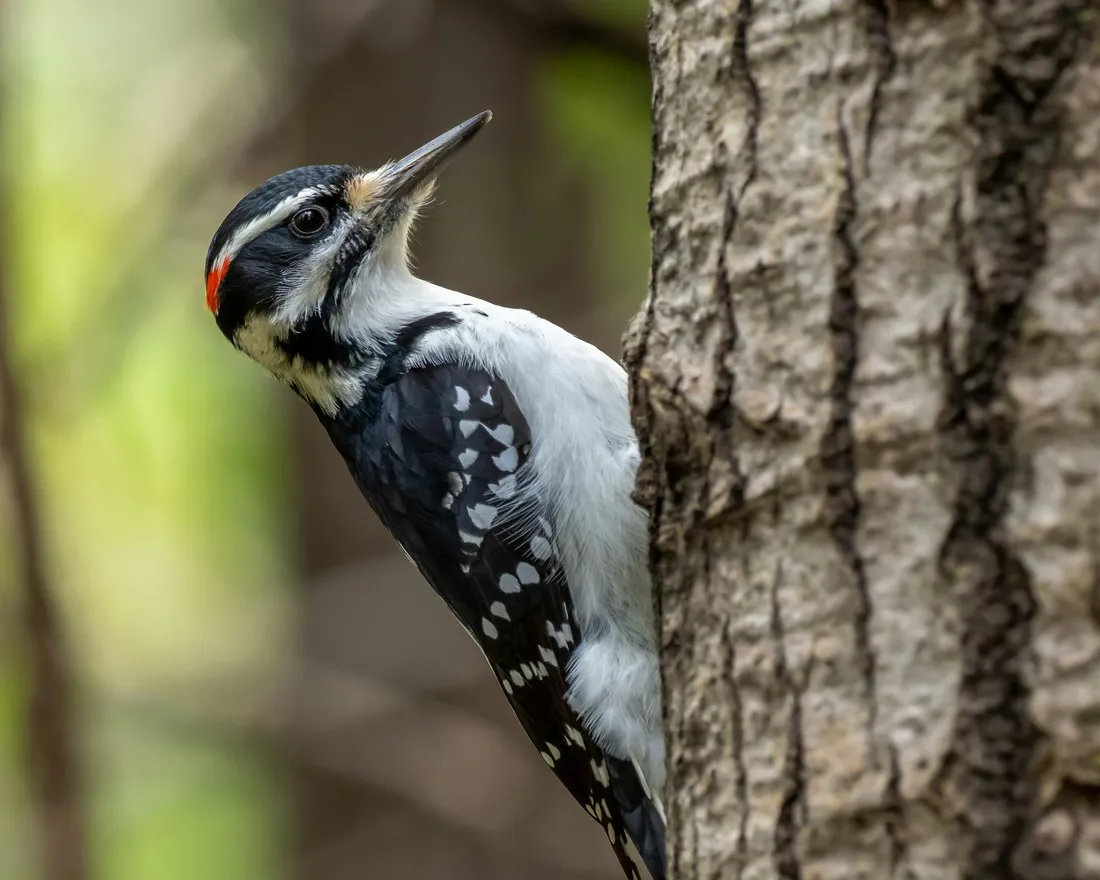
A bill like a thorn means a Downy. A bill like a chisel, nearly as long as the head, means a Hairy. Audubon adds that the Hairy “requires larger trees.”
What woodpeckers eat
In the wild, most woodpeckers eat insects, especially larvae they dig out of wood. At feeders, they want fat and protein.
| Woodpecker | Natural diet (Audubon) | Feeder foods with a source | Feeder it can use |
|---|---|---|---|
| Downy (5–7 in.) | “Mostly insects,” especially beetles and ants; also seeds and berries | “Will eat suet at bird feeders” | Any suet cage; upside-down feeders |
| Hairy (7.1–10.2 in.) | Mostly insects, especially larvae of wood-boring beetles; some berries, seeds, nuts | “Will come to bird feeders for suet” | Suet cage; tail prop helps |
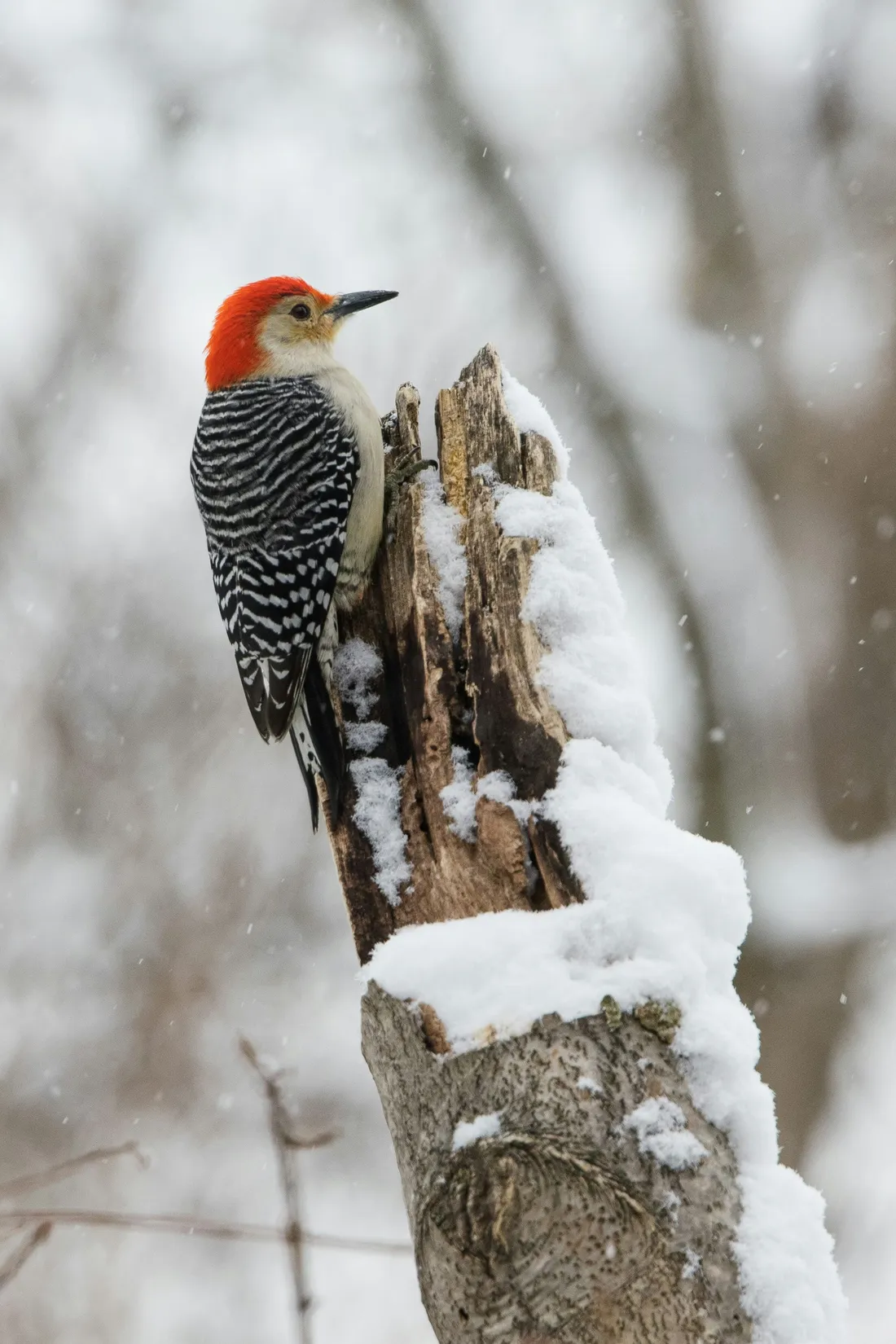
| Red-bellied (9.4 in.) | “Omnivorous”; diet “may be more than 50% plant material at some seasons” | “Has been known to be attracted to suet feeders” | Suet cage with tail prop; peanuts |
| Northern Flicker (11–12 in.) | “Probably eats ants more frequently than any other North American bird”; forages by hopping on the ground | Not listed on Audubon’s page; FeederWatch shows flickers at feeders (table above) | Large suet feeder with tail prop |
| Pileated (16–19 in.) | Mostly ants and other insects; carpenter ants “may be up to 60%” of the diet; also fruit and nuts | Not listed on Audubon’s page; FeederWatch shows Pileateds at feeders in MN and MI | Long tail-prop suet feeder |
| Red-headed (10 in.) | “Perhaps the most omnivorous of woodpeckers”; catches insects in flight; stores acorns and beechnuts in fall | Not listed on Audubon’s page | — |
| Yellow-bellied Sapsucker (7.1–8.7 in.) | Insects, tree sap from “tiny holes” drilled in rows, fruit | Not listed on Audubon’s page | — |
Diet and lengths from Audubon’s field guide: Downy, Hairy, Red-bellied, Northern Flicker, Pileated, Red-headed, Yellow-bellied Sapsucker. The “feeder it can use” column is our reading of each bird’s size and the feeder designs below.
Woodpecker sizes, bill tip to tail tip
Length (Audubon field guide)
- Downy5–7 in.
- Hairy7.1–10.2 in.
- Yellow-bellied Sapsucker7.1–8.7 in.
- Red-bellied9.4 in.
- Red-headed10 in.
- Northern Flicker11–12 in.
- Pileated16–19 in.
The foods that work at feeders:
| Food | What the source says | When |
|---|---|---|
| Suet | Audubon’s winter guide lists “woodpeckers, titmice, nuthatches, chickadees” at suet feeders (Audubon). Nebraska Extension: suet is “especially attractive to insect-eaters such as woodpeckers” (Nebraska Extension) | Best in cold weather (see the year table below) |
| Peanuts | “Woodpeckers, jays, nuthatches, chickadees, and titmice will readily visit a feeder for this high-protein, high-energy food.” Audubon adds: “Be sure they’re de-shelled, dry-roasted, and unsalted” (Audubon) | Year-round |
| Mealworms | Nebraska Extension lists woodpeckers among the birds mealworms attract | Year-round |
| No-melt suet dough | “Commercial no-melt suet preparations can be used throughout the year” (Nebraska Extension) | Warm months |
| Fruit | Red-headed Woodpeckers and sapsuckers eat fruit (Audubon field guide) | Fall and winter |
Black-oil sunflower feeds almost every other feeder bird, and some woodpeckers take seeds, but it isn’t what draws them. For how the seeds compare, see types of bird seed. For the full cold-weather menu, see what to feed birds in winter.
Skip salted or flavored peanuts and anything moldy. We don’t recommend peanut butter straight from the jar, because we found no Cornell or Audubon guidance that supports it.
The best feeders for woodpeckers
Woodpeckers cling to trunks rather than perch, so they need a feeder they can grip. Here are the main types:
| Feeder type | Suits | Why |
|---|---|---|
| Simple suet cage | Downy, Hairy, Red-bellied | Cheap and easy to clean. Small birds use it too |
| Suet feeder with a tail prop | Hairy, Red-bellied, flicker, Pileated | A board below the cage where woodpeckers can brace their tails. Duncraft describes woodpeckers “using the tail rest for stability” (Duncraft) (maker’s design rationale) |
| Long tail-prop feeder | Pileated, flicker | Same idea with a longer board. Birds Choice’s 2-cake model has a 9.5-inch tail prop (Birds Choice); its single-cake model has a 5.5-inch prop (Birds Choice) |
| Upside-down suet feeder | Downy, Hairy, Red-bellied | Birds feed from below. Duncraft says feeding upside down is “natural for woodpeckers, and not preferred by starlings” (Duncraft) (maker’s claim) |
| Mesh peanut feeder | Smaller woodpeckers and other peanut eaters | Holds shelled peanuts; birds pick pieces through the mesh |
| Squirrel-resistant suet feeder | Small birds (cage-in-cage); larger birds too (weight-activated) | Keeps squirrels from emptying the suet |
The “suits” column is our reading of each design and the birds’ sizes, not test results.
If squirrels are the problem, consider the Brome Squirrel Buster Suet (opens in a new tab). It’s weight-activated and holds two cakes. On October 11, 2026, it was $109.95 on Brome’s US store (Brome) and $119.95 at Duncraft (Duncraft), and both listed it as available. For seed feeders, see our squirrel-proof bird feeder picks.
Suet cages collect old fat and droppings. Our guide on how to clean a bird feeder covers suet cages too.
Where to hang a woodpecker feeder
- On or near a trunk or post. Audubon describes Downies foraging on “trunks and major limbs of trees,” so a feeder on a trunk or sturdy post fits the way they feed. This is our practical suggestion, not a sourced rule.
- In shade. Nebraska Extension: “It is best to keep suet in shade so that it doesn’t melt.”
- Away from the house walls. A feeder on your siding invites woodpeckers to inspect the siding (see the damage section).
- Out of squirrel reach. Squirrels can easily reach a feeder on a trunk. If they keep emptying it, move the suet to a baffled pole at least 10 feet from anything they can jump from. See where to put a bird feeder, how to keep squirrels off a bird feeder, how to install a squirrel baffle and bird feeder pole systems.
Trees, snags and dead limbs
Dead wood is both pantry and nursery for woodpeckers. Johnny Stowe, a South Carolina DNR wildlife biologist, explains that Downy, Hairy, Red-bellied, Pileated and Red-headed Woodpeckers feed heavily on wood-boring beetle larvae in snags (standing dead trees). He adds: “Woodpeckers are also the primary excavators of nesting cavities in snags.” Other cavity nesters use those holes later (SC DNR, Dec 23, 2014).
The same release says that “in woodlots, at least four to five snags per acre should be maintained.” It also warns: “Snags that are near homes or other structures may need to be removed for safety reasons.”
Dead trees matter most for one species. Audubon says the Red-headed Woodpecker has been decreasing for years. The reasons are “not well known” but probably include the loss of nest sites as dead trees are cut and competition with starlings for nest cavities (Audubon).
Our safety rule of thumb (not an agency rule): if a dead tree or limb could hit your house, car, deck, fence, play area or a path when it falls, take it down. Or have an arborist cut it back to a shorter, safe stub. Leave the rest standing. Keep oaks and beeches too if you have them: Audubon says Red-headed Woodpeckers gather acorns and beechnuts in fall and store them for winter.
Nest boxes for woodpeckers
Woodpeckers dig their own holes, so a nest box is a bonus, not the main draw. The right size depends on the species, and the two sources we read disagree about the flicker.
| Northern Flicker (NestWatch) | Northern Flicker (OSU) | Hairy (OSU) | Downy (OSU) | |
|---|---|---|---|---|
| Entrance hole | 2½ in. | 2½ in. | 1⅝ in. | 1¼ in. |
| Floor | 7¼ × 7¼ in. | 10 × 10 in. | 6 × 6 in. | 6 × 6 in. |
| Depth / side height | 24 in. inside depth | 16–18 in. sides | 12–15 in. sides | 9 in. sides |
| Hole above floor | not stated | 14–16 in. | 9–12 in. | 7 in. |
| Height above ground | 6–12 ft | 5–25 ft | 5–25 ft | 5–25 ft |
| Fill | “Completely pack the box to the top with white pine wood chips” | About an inch of shavings or chips | Same | Same |
Sources: NestWatch, Northern Flicker; Oregon State University Extension EC 1556 (published June 2002, reviewed 2023). OSU places all three “5-25 ft high on dead tree at edge of a forest.” Its table is written for the Pacific Northwest.
Nest box specs at a glance
Northern Flicker
- Entrance hole
- 2½ in. (NestWatch and OSU agree)
- Floor
- 7¼ × 7¼ in. (NestWatch); 10 × 10 in. (OSU)
- Depth
- 24 in. inside depth (NestWatch); 16–18 in. sides, hole 14–16 in. above the floor (OSU)
- Height above ground
- 6–12 ft (NestWatch); 5–25 ft (OSU)
- Fill
- Pack to the top with white pine chips (NestWatch); about an inch (OSU)
Hairy Woodpecker (OSU)
- Entrance hole
- 1⅝ in.
- Floor
- 6 × 6 in.
- Depth
- 12–15 in. sides; hole 9–12 in. above the floor
- Height above ground
- 5–25 ft
- Fill
- About an inch of shavings or chips
Downy Woodpecker (OSU)
- Entrance hole
- 1¼ in.
- Floor
- 6 × 6 in.
- Depth
- 9 in. sides; hole 7 in. above the floor
- Height above ground
- 5–25 ft
- Fill
- About an inch of shavings or chips
Where the two differ, we follow NestWatch for the flicker, because its plan is written for that species. We couldn’t find NestWatch pages for the Downy or Hairy, so those columns use OSU only.
Flicker box setup, from NestWatch:
- Face it south or east, in “a shady area, near sparsely scattered trees, with an open flyway.”
- Mount it “on a pole equipped with a baffle at least 10’ from the nearest tree.” Our squirrel baffle guide covers the baffle.
- Pack it with chips and replace them “with fresh wood chips every year by April 1.”
- Space boxes 330 feet apart.
- Expect starlings: “European Starlings can usurp cavities occupied by flickers even when additional nest boxes are offered nearby.”
Use chips, not sawdust. OSU says: “Do not use sawdust, because it soaks up water and gets matted down.”
Water
Woodpeckers don’t need a special bath. Audubon notes that “many kinds of birds bathe in and drink from open water in frigid weather” and suggests a plastic bath with a built-in heater, since ceramic can crack in the cold (Audubon). See best heated bird baths and how to keep a bird bath from freezing.
A woodpecker-friendly year
| Season | What woodpeckers are doing | What to do |
|---|---|---|
| Winter | Visiting suet feeders | Keep suet full; open water |
| Early spring | Drumming and drilling peak. CT DEEP: “Spring is the most active period as woodpeckers are both drumming and drilling” | Fresh chips in flicker boxes by April 1 (NestWatch); fix siding holes promptly |
| Spring–summer | Nesting. USFWS says control measures at a house must wait until any active nest’s young have left, usually around midsummer | Clean feeders more often in heat |
| Summer | Raising young | CT DEEP: no suet in hot summer months. Switch to peanuts or no-melt dough in shade |
| Fall | CT DEEP: drilling in houses “increases in fall as the holes may serve as winter roost cavities” | Put suet back up; watch the siding |
A woodpecker-friendly year
Winter
- Woodpeckers
- Visiting suet feeders
- Do
- Keep suet full; open water
Early spring
- Woodpeckers
- Drumming and drilling peak (CT DEEP)
- Do
- Fresh chips in flicker boxes by April 1 (NestWatch); fix siding holes promptly
Spring–summer
- Woodpeckers
- Nesting; control measures at a house wait until the young have left (USFWS)
- Do
- Clean feeders more often in heat
Summer
- Woodpeckers
- Raising young
- Do
- No suet in hot months (CT DEEP); peanuts or no-melt dough in shade
Fall
- Woodpeckers
- Drilling in houses increases; holes may serve as winter roosts (CT DEEP)
- Do
- Put suet back up; watch the siding
Seasons shift with latitude. The “what to do” column is our summary of the sources cited.
Will woodpeckers damage my house?
Fear of siding damage stops many people from attracting woodpeckers. Here’s what the agencies say.
Why they do it. Connecticut DEEP says drumming and drilling are “related to breeding and territorial behavior and may occur in fall or spring.” Drumming “rarely results in any significant damage to the home,” though it can be an annoyance for several weeks in early spring (CT DEEP). The US Fish and Wildlife Service says that if woodpeckers start pecking at your house, you should “inspect your siding for insect damage,” and that rotting wood appeals to cavity-nesting birds (USFWS).
Which houses. CT DEEP: “Woodpeckers are attracted to natural, dark-stained, unpainted cedar and redwood siding.”
What works:
- Feed them elsewhere. CT DEEP: “Keeping a feeder full of suet may draw woodpeckers away from the house.” Hang it well away from the walls.
- Cover holes promptly. CT DEEP recommends that “holes be covered promptly with sheet metal or fine hardware cloth.”
- Netting. “Bird netting can be attached to the eaves and angled back to the siding below the damaged area” (CT DEEP). USFWS says “physical exclusion is probably the most effective control method” and that netting “needs to be taut and maintained.”
- Scare devices, with low expectations. CT DEEP lists flash tape, balloons and pie plates, and says stationary model owls are not usually effective. USFWS says owl and hawk models, spinners and windsocks “have inconsistent success.”
- Permanent fix. For homes with repeated damage, CT DEEP recommends bird netting or “protective aluminum or vinyl siding,” calling both “a permanent long-term solution.”
What not to do. USFWS: “Avoid tactile deterrents, like gels or sticky substances, because these can impair flight and ability for birds to stay warm.”
The law. USFWS: “The Migratory Bird Treaty Act protects more than a thousand species of birds, including woodpeckers.” A homeowner can apply for a depredation permit for some species only “as a last resort,” USFWS says, and “permits will be issued only if non-lethal methods have previously been tried and failed.” CT DEEP adds that lethal removal “can only legally be done with a federal depredation permit issued by the U.S. Fish and Wildlife Service.” Your state wildlife agency may have its own rules too.
Related guides
Sources
- Project FeederWatch, Top 25 Feeder Birds 2024–25: MI, MN, OH, PA, NY, VA, GA, TX, CO, WA, CA
- Audubon field guide: Downy, Hairy, Red-bellied, Northern Flicker, Pileated, Red-headed, Yellow-bellied Sapsucker
- Audubon: Guide to winter bird feeding (Nov–Dec 2010), Top 10 foods for winter bird feeding, Winterize your yard for birds
- NestWatch, Northern Flicker nest box
- Oregon State University Extension, EC 1556 Build Nest Boxes for Wild Birds
- South Carolina DNR, snags release (Dec 23, 2014)
- Connecticut DEEP, Problems with Woodpeckers (updated Sept 13, 2018)
- US Fish and Wildlife Service, Woodpeckers and your home; Migratory Bird Treaty Act
- Nebraska Extension, G2003 Backyard Wildlife: Feeding Birds (March 2010)
- Products: Brome Squirrel Buster Suet (Brome), Brome Squirrel Buster Suet (Duncraft), Birds Choice 2-cake tail-prop feeder, Birds Choice single-cake tail-prop feeder, Duncraft Eco-Strong Upside Down Suet, Duncraft Eco-Strong Tail Prop
Frequently asked questions
- What is the best food to attract woodpeckers?
- Suet in cold weather and unsalted peanuts year-round. Audubon lists woodpeckers first among the birds at suet feeders and says woodpeckers readily visit feeders for peanuts. Nebraska Extension adds that mealworms also attract woodpeckers.
- Do woodpeckers eat bird seed?
- Some take seeds, but seed isn't what draws them. Audubon's field guide says Downy Woodpeckers also eat seeds and berries, Hairy Woodpeckers eat some seeds and nuts, and Red-bellied Woodpeckers can get more than half their diet from plant food at some times of year. Suet and peanuts are the reliable draws.
- How do I attract a Pileated Woodpecker?
- Live near big trees and be patient. Audubon says Pileateds favor mature forest but also live in woodlots where some large trees are present, and even in parks around the edges of large cities. In the 2024–25 Project FeederWatch season, they visited 45% of Minnesota sites and 31% of Michigan sites, and weren't in the top 25 feeder birds in Ohio, Pennsylvania or New York. Offer suet in a feeder with a long tail prop.
- Will a woodpecker use a birdhouse?
- Northern Flickers are the best candidate. NestWatch publishes a flicker box plan (2½-inch hole, 24 inches deep) and says to pack the box to the top with white pine wood chips. Oregon State Extension also lists box sizes for Downy and Hairy Woodpeckers. Woodpeckers normally dig their own holes, so a box is a bonus, not a guarantee.
- Will feeding woodpeckers make them drill my house?
- Connecticut's wildlife agency says the opposite can happen: keeping a feeder full of suet may draw woodpeckers away from the house. Drilling on houses is tied to breeding, territory and fall roost holes. Hang feeders away from the walls.
- Can I feed woodpeckers suet in summer?
- Connecticut DEEP says not to put out suet in hot summer months because it may get sticky and stick to a bird's feathers. Nebraska Extension says no-melt suet can be used year-round and that suet should be kept in shade. Peanuts are the simplest summer option.
- Is it legal to get rid of a woodpecker?
- Scaring and excluding them is the normal approach. The US Fish and Wildlife Service says the Migratory Bird Treaty Act protects woodpeckers, and a homeowner can apply for a depredation permit only as a last resort, after non-lethal methods have been tried and failed.
Keep reading

Written by
Research and editing
The Feeder Field editorial team researches backyard birding gear and bird feeding for US readers. We compare manufacturer specifications, subscription terms and long-term owner feedback, and we check feeding and bird-behavior advice against the Cornell Lab of Ornithology, Audubon and university extension services. Articles are drafted with the help of AI tools, then fact-checked and edited by our team before they go live. Every guide says whether it is researched or hands-on tested, and we update buying guides at least every six months.