Guide
Common Backyard Birds of the Northeast: Who Visits Your Feeder (and When)
The birds Northeast feeders really get, state by state from Project FeederWatch data: how to spot each one, what it eats and when it's here.
Updated
Disclosure: We may earn a commission when you buy through links on this page. Read our affiliate disclosure.
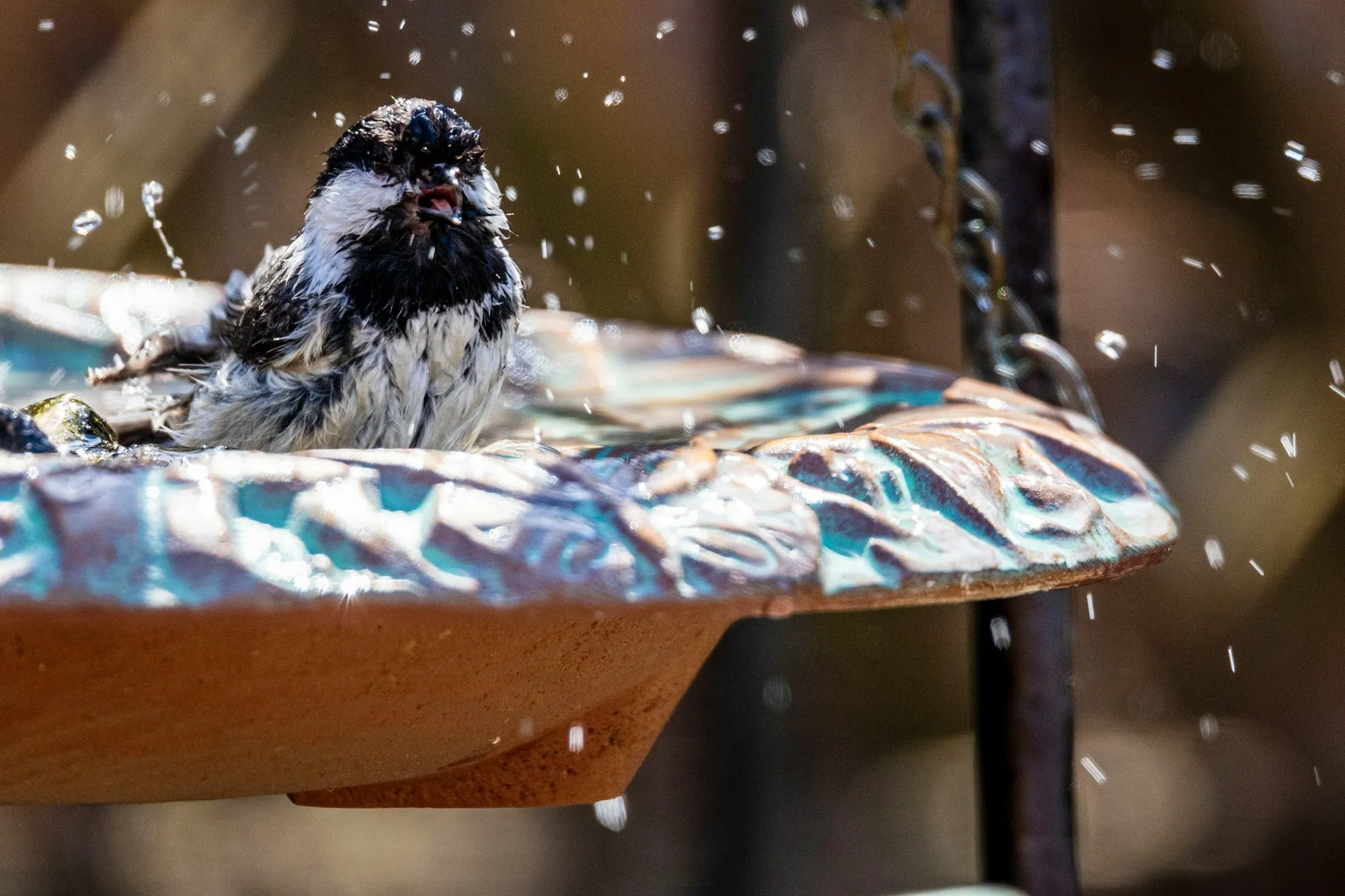
If you’re trying to put names to the common backyard birds of the Northeast, start with those seven. Below are the state-by-state numbers, which birds are here all year, which come only for the winter, and which are summer-only. Each bird gets a line on how to spot it and a line on the food that brings it in.
The Northeast’s top feeder birds, state by state
“The Northeast” here means the nine states the US Census Bureau groups as the Northeast: Connecticut, Maine, Massachusetts, New Hampshire, Rhode Island and Vermont (New England), plus New Jersey, New York and Pennsylvania (CDC/NCHS).
The table shows FeederWatch’s “Percentage of Sites Visited” for the 2024–25 season, exactly as published on each state’s page. FeederWatch’s Explanation of Terms page has the formal definition; we couldn’t open it, so we use the figure as labeled and don’t restate the formula. A dash means the bird wasn’t in that state’s top 25.
Percentage of Sites Visited, Project FeederWatch 2024–25 (Nov–Apr)
| Bird | ME(324) | NH(233) | VT(185) | MA(661) | RI(66)small sample | CT(321) | NY(1,312) | NJ(380) | PA(971) |
|---|---|---|---|---|---|---|---|---|---|
| Black-capped Chickadee | 98.55 | 96.23 | 95.98 | 93.97 | 95.59 | 92.90 | 90.22 | 82.34* | 89.09* |
| Dark-eyed Junco | 85.76 | 89.96 | 90.45 | 89.67 | 92.65 | 93.49 | 91.23 | 92.29 | 92.76 |
| Northern Cardinal | 80.52 | 85.77 | 83.92 | 92.97 | 94.12 | 93.20 | 90.58 | 92.79 | 94.11 |
| Blue Jay | 88.37 | 90.38 | 83.42 | 90.53 | 91.18 | 90.53 | 88.99 | 91.29 | 87.07 |
| Downy Woodpecker | 84.30 | 88.28 | 82.91 | 87.66 | 95.59 | 89.64 | 87.10 | 85.07 | 87.45 |
| White-breasted Nuthatch | 87.79 | 84.94 | 86.43 | 88.24 | 86.76 | 90.53 | 85.51 | 80.85 | 82.05 |
| Tufted Titmouse | 85.47 | 92.47 | 85.43 | 87.80 | 88.24 | 90.53 | 82.25 | 85.57 | 86.10 |
| Mourning Dove | 81.10 | 80.33 | 74.87 | 86.23 | 91.18 | 86.39 | 87.17 | 90.55 | 88.51 |
| Red-bellied Woodpecker | 53.20 | 66.53 | 53.77 | 78.62 | 77.94 | 89.05 | 80.29 | 87.56 | 82.63 |
| American Goldfinch | 85.17 | 80.33 | 83.92 | 78.05 | 70.59 | 73.08 | 75.51 | 63.68 | 73.07 |
| House Finch | 49.13 | 56.49 | 45.73 | 82.07 | 88.24 | 84.62 | 75.00 | 88.56 | 88.42 |
| Hairy Woodpecker | 76.16 | 77.82 | 77.39 | 57.39 | 50.00 | 68.64 | 66.01 | 56.22 | 60.04 |
| Carolina Wren | not in top 25 | 52.72 | 43.22 | 78.62 | 86.76 | 78.40 | 57.03 | 76.12 | 74.71 |
| White-throated Sparrow | 43.90 | 39.33 | 30.65 | 52.94 | 67.65 | 72.78 | 54.20 | 75.62 | 63.32 |
| American Robin | 59.59 | 62.34 | 53.27 | 70.16 | 61.76 | 56.80 | 60.00 | 64.18 | 65.25 |
| Eastern Bluebird | 53.20 | 61.92 | 31.16 | 43.33 | 27.94 | 47.63 | not in top 25 | not in top 25 | 38.61 |
Header numbers are how many FeederWatchers reported from each state. *New Jersey and Pennsylvania list “Carolina/Black-capped Chickadee” as one entry (see the chickadee section below). †Small sample: Rhode Island’s list rests on 66 FeederWatchers, so its numbers can swing much more from year to year than New York’s (1,312).
Sources: FeederWatch Top 25, 2024–25, for ME, NH, VT, MA, RI, CT, NY, NJ, PA (read October 11, 2026).
One limit to keep in mind: the FeederWatch season runs from November 1 through April 30 (FeederWatch). These are winter numbers. Summer-only birds such as hummingbirds and orioles never show up in them.
What the numbers show
These are our readings of the 2024–25 data, not range statements:
- The top bird changes as you go south. The chickadee is number one in Maine, New Hampshire, Vermont and Massachusetts, and ties the Downy Woodpecker (95.59%) in small-sample Rhode Island. The junco leads in Connecticut and New York, and the cardinal in New Jersey and Pennsylvania.
- Northern New England is its own feeder region. In Maine, New Hampshire and Vermont, House Finches were at 46% to 56% of sites, against 75% to 89% in the other six states. Red-bellied Woodpeckers show the same split (53% to 67% up north, 78% to 89% elsewhere). Hairy Woodpeckers run the other way: 76% to 78% in the three northern states, 50% to 69% farther south.
- The Carolina Wren is a southern-tier regular. It ranks 10th or 11th in Massachusetts, Rhode Island, Connecticut, New Jersey and Pennsylvania, but isn’t in Maine’s top 25 at all.
- Some birds show up only in the north. The Red-breasted Nuthatch made the top 25 only in Maine, New Hampshire and Vermont. The Purple Finch made it in those three and New York.
- Bluebirds in winter. The Eastern Bluebird ranks 13th in New Hampshire (61.92%) and 14th in Maine (53.20%), in counts that run through the coldest months.
Year-round residents
Audubon’s field guide describes each of these as a permanent or mostly permanent resident. Each card’s sources are the Audubon page linked in its heading and the FeederWatch state pages above. Food lines match our types of bird seed guide.
Black-capped Chickadee (Poecile atricapillus)
- Spot it: A small bird with a black cap and bib, a gray back and a buff wash on its sides.
- At the feeder: Seeds or suet. Audubon says it may take sunflower seeds one at a time and fly off to stuff them into bark crevices.
- Northeast numbers: Maine 98.55% (the highest figure for any bird in any Northeast state), Vermont 95.98%, New York 90.22%.
- Regional note: Audubon says it occasionally stages fall “invasions,” with large numbers flying south, mostly in the northeastern states and southeastern Canada.
Tufted Titmouse (Baeolophus bicolor)
- Spot it: Mostly gray and white, with a crest, a pale face, a black forehead and rusty sides. The song is a whistled “peter-peter.”
- At the feeder: Sunflower seeds, often carried off one at a time, plus suet. Whole peanut kernels and striped sunflower were among its preferred foods in the 1980 Geis feeding study (see our seed guide).
- Northeast numbers: New Hampshire 92.47%, Connecticut 90.53%, Maine 85.47%.
- Regional note: Audubon says titmice have been “steadily pushing north” and that “Feeders may be helping it to expand its range.” It ranks second in New Hampshire.
White-breasted Nuthatch (Sitta carolinensis)
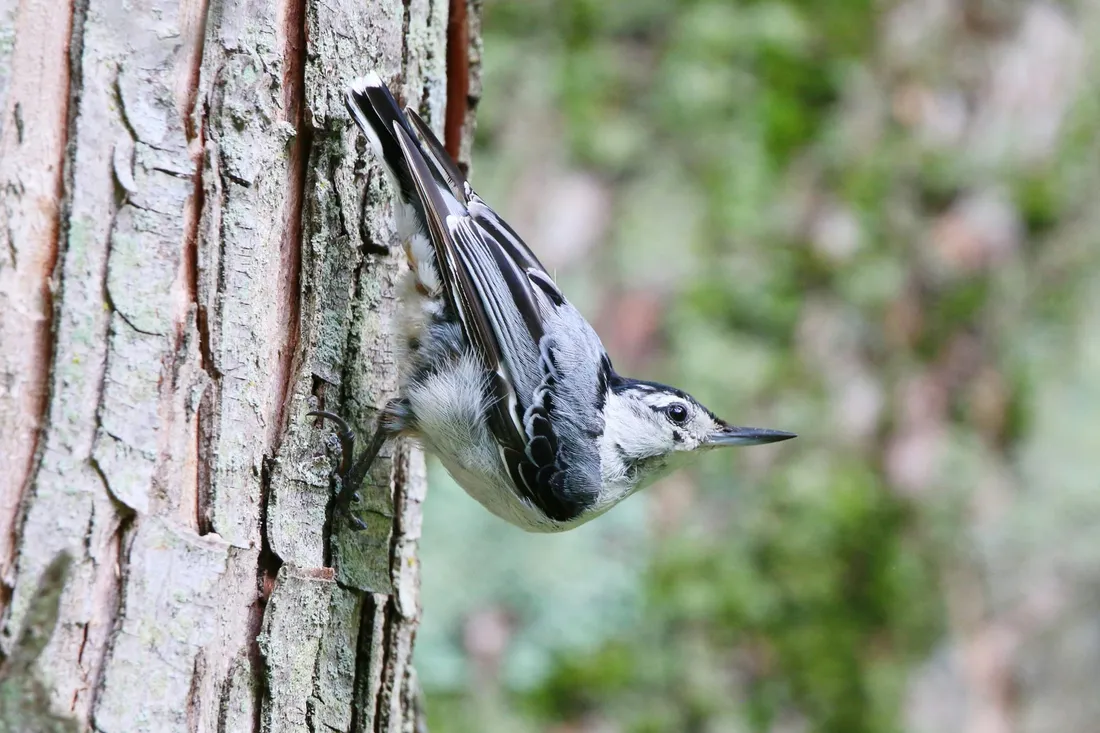
- Spot it: A gray-backed bird with a white face and chest, a beady black eye and a black crown stripe (often gray on females).
- At the feeder: Audubon calls it “Readily attracted to bird feeders for sunflower seeds or suet.”
- Northeast numbers: Connecticut 90.53%, Massachusetts 88.24%, Maine 87.79%.
- Regional note: It needs big trees. Audubon says it lives in suburbs and parks as long as large trees are present.
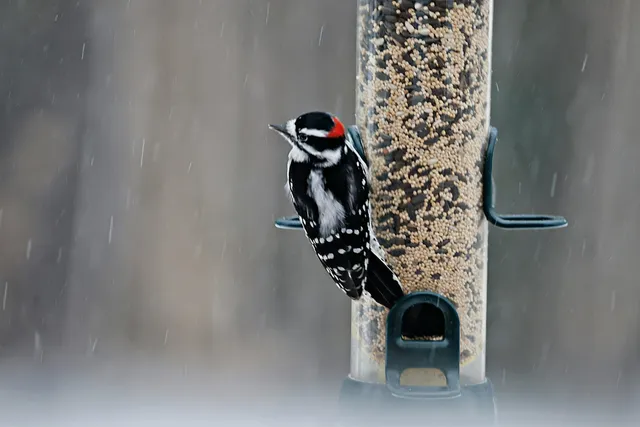
Downy Woodpecker (Dryobates pubescens)
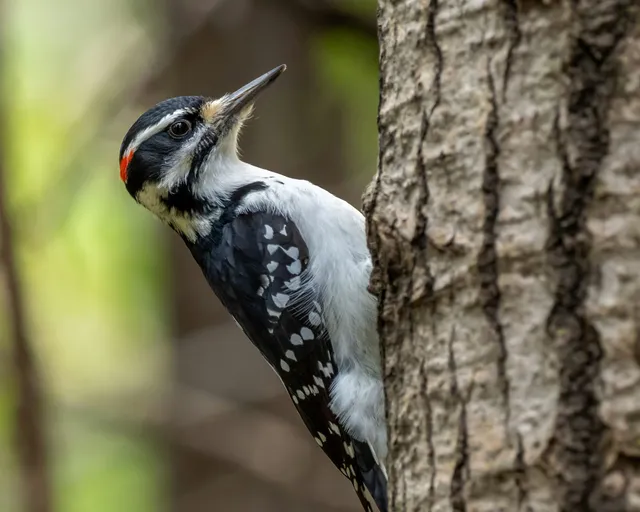
- Spot it: The smallest woodpecker on this page (5 to 7 inches), with a white back, a “very short, stubby bill” and black bars on its white outer tail feathers. Males have a red spot on the nape.
- At the feeder: Audubon says it “Will eat suet at bird feeders.”
- Northeast numbers: Rhode Island 95.59%, Connecticut 89.64%, Pennsylvania 87.45%.
- Regional note: It ranked in the top eight in every Northeast state. To tell it from the Hairy, see the look-alikes section below.
Hairy Woodpecker (Leuconotopicus villosus, as FeederWatch lists it)
- Spot it: Like a large Downy, about robin-sized (7 to 10 inches), with a bill nearly as long as its head and clean white outer tail feathers.
- At the feeder: Suet.
- Northeast numbers: New Hampshire 77.82%, Vermont 77.39%, Maine 76.16%.
- Regional note: It makes the top 10 in all three northern New England states, then drops to 50% to 69% of sites from Massachusetts south.
Red-bellied Woodpecker (Melanerpes carolinus)
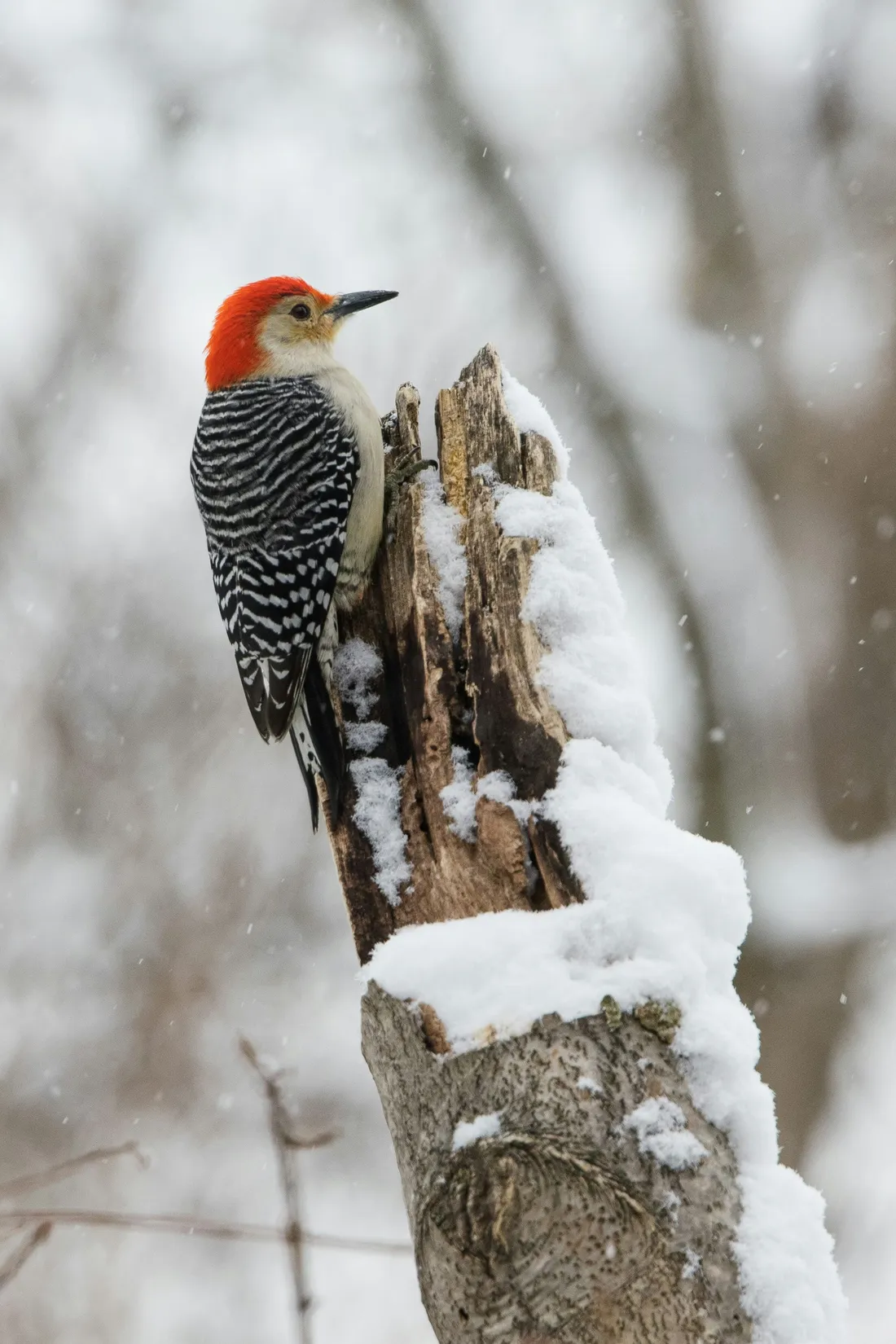
- Spot it: Narrow black-and-white bars on the back and a buffy face. Males have red on the forehead, crown and nape; females only on the nape. As Audubon puts it, “Despite name, red on belly is usually hard to see.”
- At the feeder: Suet; striped sunflower was a preferred seed in the Geis study.
- Northeast numbers: Connecticut 89.05%, New Jersey 87.56%, Maine 53.20%.
- Regional note: Audubon says it “has expanded its range northward in more recent decades.” The data fit: it’s a top-10 bird in New York, New Jersey, Pennsylvania and Connecticut, but ranks 11th to 15th in northern New England.
Northern Cardinal (Cardinalis cardinalis)
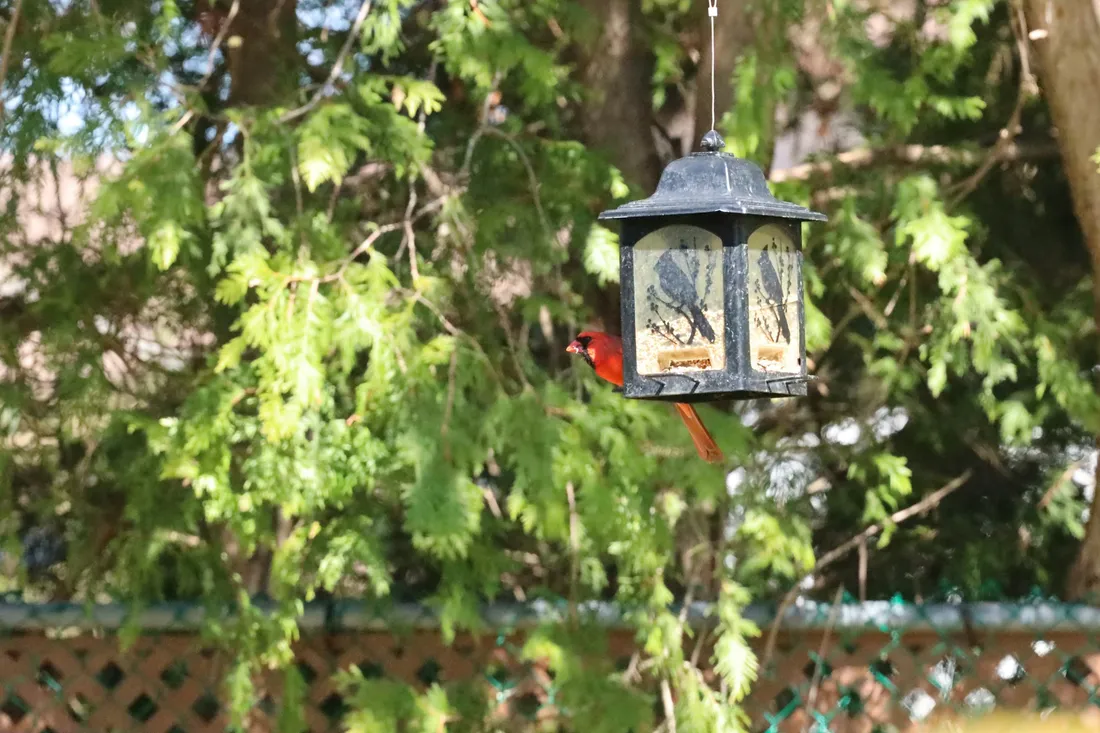
- Spot it: Audubon calls the male “our only red bird with a crest.” Females are duller but also crested, with “a massive pink bill.”
- At the feeder: Audubon says it “favors sunflower seeds.” See how to attract cardinals.
- Northeast numbers: Rhode Island 94.12%, Pennsylvania 94.11%, Maine 80.52%.
- Regional note: Audubon says cardinals have been extending their range northward for decades and that sunflower feeders “may have aided its northward spread.” Even Maine’s figure is above 80%.
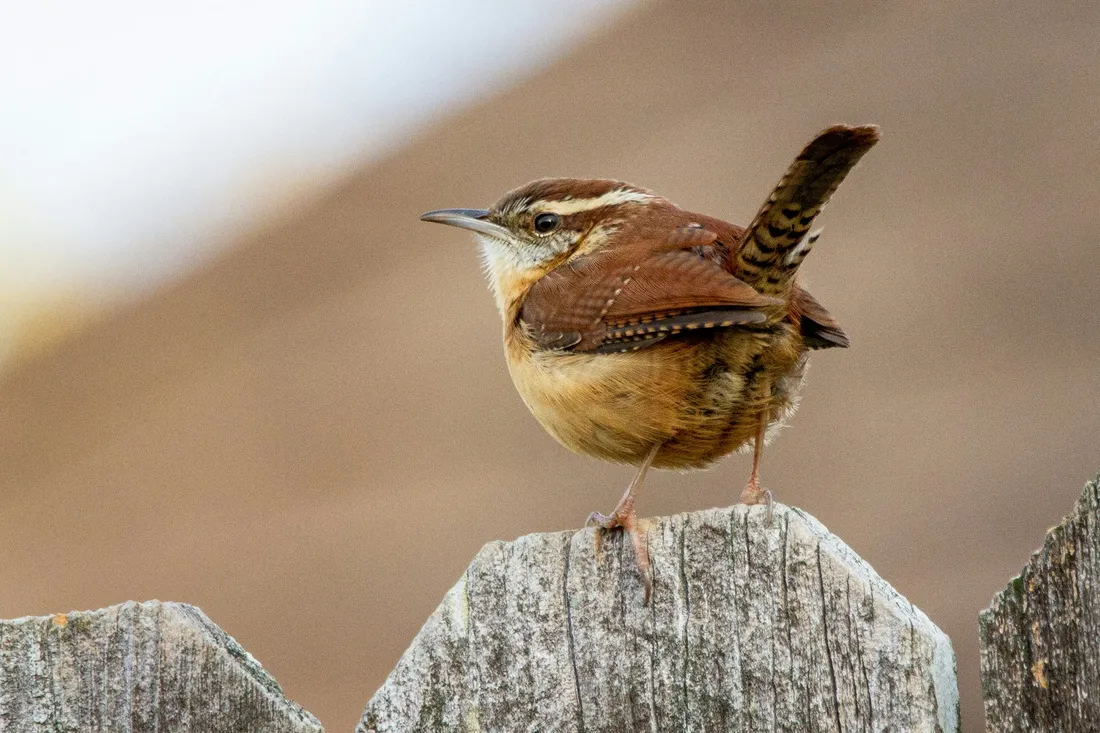
Carolina Wren (Thryothorus ludovicianus)
- Spot it: A sparrow-sized wren, chestnut above and “butterscotch below,” with a bold white eyebrow.
- At the feeder: Audubon says it sometimes comes for suet and peanuts.
- Northeast numbers: Rhode Island 86.76%, Massachusetts 78.62%, Vermont 43.22%.
- Regional note: Audubon says this wren “gradually expands northward during series of mild years” and gets knocked back south by very severe winters. Our suggestion: keep suet up through hard cold snaps.
Partial migrants: some stay, some leave
Audubon describes each of these as present in winter across much of its range, while some birds move south. You may see them all year, but not always the same birds or the same numbers.
Blue Jay (Cyanocitta cristata)
- Spot it: Blue crest, black necklace, white wing bars and white tail corners.
- At the feeder: Seeds or suet. Peanut kernels were a preferred food for Blue Jays in the Geis study. Audubon says it pounds hard nuts open with its bill and stores acorns in holes in the ground.
- Northeast numbers: New Jersey 91.29%, Rhode Island 91.18%, Vermont 83.42%.
- Regional note: It ranked fifth or better in six of the nine states. Audubon says some years bring big southward flights, “with thousands on the move.”
Mourning Dove (Zenaida macroura)
- Spot it: A slim, plain dove (9 to 13 inches) with black spots on the wings and a long, pointed tail that shows white spots along the edge in flight.
- At the feeder: Seeds are about 99 percent of its diet, Audubon says, often eaten “on the ground under elevated feeders.” White proso millet and black-oil sunflower both suit it.
- Northeast numbers: Rhode Island 91.18%, New Jersey 90.55%, Vermont 74.87%.
- Regional note: Audubon says many move south from northern areas in fall. Vermont had the region’s lowest figure.
American Goldfinch (Spinus tristis)
- Spot it: In winter, yellowish-brown to gray with bold wing bars on black wings. The bright yellow male with a black forehead is the summer look.
- At the feeder: Audubon says it “Commonly comes to feeders for small seeds.” Nyjer and hulled sunflower are the usual picks.
- Northeast numbers: Maine 85.17%, Vermont 83.92%, New Jersey 63.68%.
- Regional note: It ranked higher in the north (sixth in Maine) than the south (17th in New Jersey). Audubon says more goldfinches stay north in winters with good food supply.
House Finch (Haemorhous mexicanus)
- Spot it: Males have a red forehead and eyebrow against a brown cap, a red throat and chest, and dark streaks on the sides. Females have plain brown faces and blurry streaks all over.
- At the feeder: Seeds, especially sunflower, Audubon says.
- Northeast numbers: New Jersey 88.56%, Pennsylvania 88.42%, Vermont 45.73%.
- Regional note: House Finches are native to the West. Audubon says the eastern population began in 1940, when New York pet shop owners who had been selling them illegally released their birds. It also says conjunctivitis has hit some local populations hard, so keep feeders clean (how to clean a bird feeder).
Song Sparrow (Melospiza melodia)
- Spot it: A brown, streaky sparrow with a fairly long tail, a striped face, and chest streaks that often run together into a central blotch.
- At the feeder: Audubon says it “Will come to bird feeders placed close to good cover.” It feeds mostly on the ground; white proso millet suits it.
- Northeast numbers: Rhode Island 75.00%, Pennsylvania 65.83%, New Hampshire 41.84%.
- Regional note: Put the millet tray near shrubs. Audubon’s feeding notes for this sparrow and the White-throated both stress cover.
American Robin (Turdus migratorius)
- Spot it: Brick-red chest, gray back, and small white spots around the eyes.
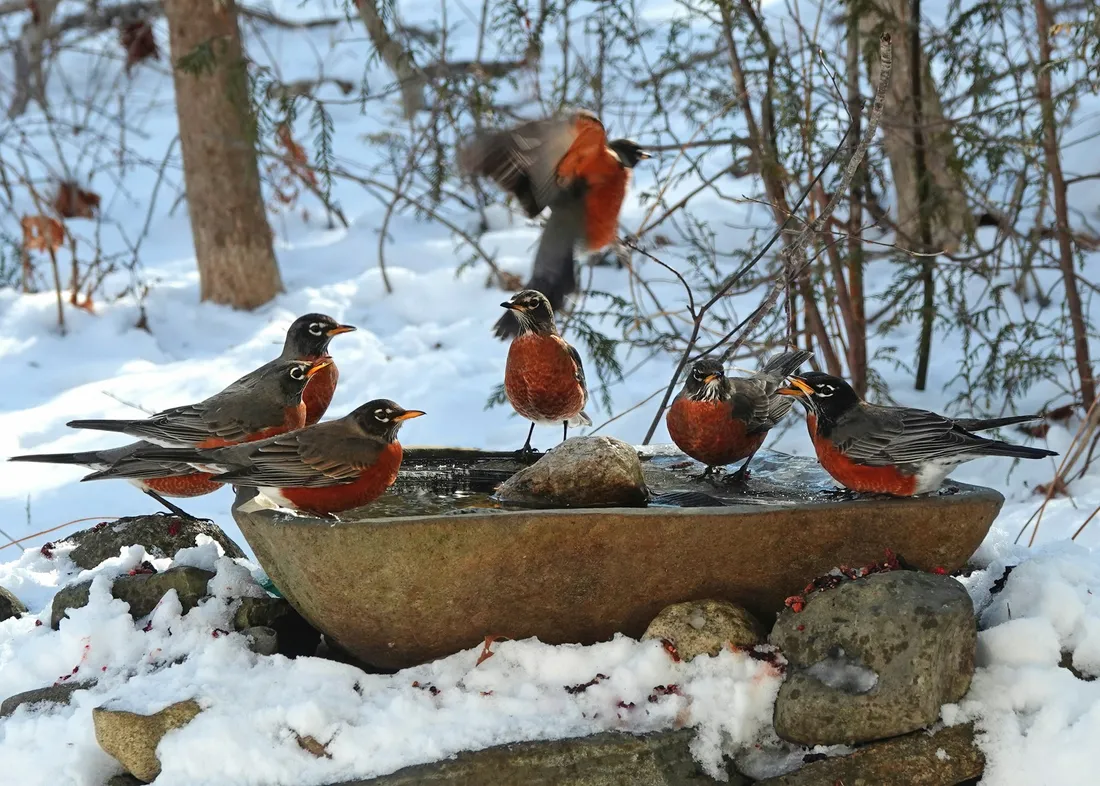
- At the feeder: Audubon doesn’t mention feeders. In winter it feeds heavily on fruit, mainly wild berries, so berry shrubs and open water are your best bets.
- Northeast numbers: Massachusetts 70.16%, Pennsylvania 65.25%, Vermont 53.27%.
- Regional note: Audubon says some robins winter as far north as Canada, in local flocks wherever berry crops are good, and “the first robin of spring” may be a bird that wintered only a few miles away.
Eastern Bluebird (Sialia sialis)
- Spot it: Males are bright blue above, reddish brown on the throat and chest, with a white belly. Females are paler and duller.
- At the feeder: Audubon doesn’t mention feeders and says it eats many berries, especially in winter. Our winter feeding guide covers mealworms.
- Northeast numbers: New Hampshire 61.92%, Maine 53.20%, Rhode Island 27.94%.
- Regional note: Audubon says that in the north it arrives early in spring and lingers late in fall. Even so, it ranked 13th in New Hampshire’s November-to-April counts.
Northern Flicker
- Spot it: A brown woodpecker with narrow black bars on the back, a black chest patch, a spotted belly and, in the East, bright yellow under the wings and tail.
- At the feeder: Audubon doesn’t mention feeders. It eats mostly ants and other insects, plus fruit and berries in fall and winter.
- Northeast numbers: Rhode Island 66.18%, Connecticut 48.82%, Pennsylvania 39.38%.
- Regional note: Audubon says flickers from Canada are strongly migratory and that big fall flights move down the Atlantic Coast.
Winter visitors
These birds are mainly here in the colder months, or they come south in some years and not others.
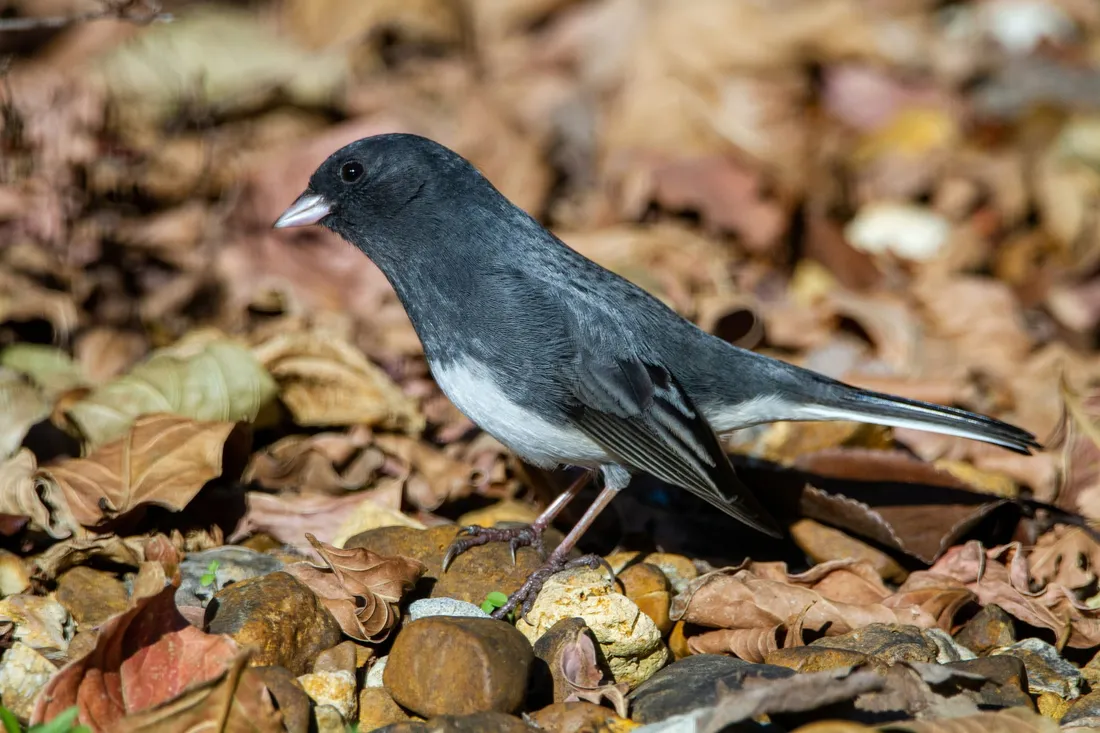
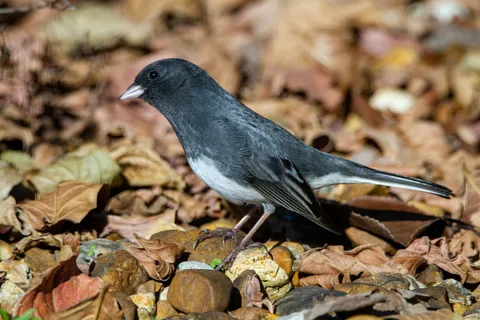
Dark-eyed Junco (Junco hyemalis)
- Spot it: A sparrow-sized bird. The “Slate-colored” form is solid gray on the head, back and sides, and juncos show white outer tail feathers when they fly.
- At the feeder: It “tends to forage on the ground under the feeding tray,” Audubon says. White proso millet was its preferred food in the Geis study.
- Northeast numbers: Connecticut 93.49%, Pennsylvania 92.76%, Maine 85.76%.
- Regional note: It was the only bird above 85% of sites in every Northeast state. Audubon says winter flocks gather at woodland edges and in suburban yards.
White-throated Sparrow (Zonotrichia albicollis)
- Spot it: A white throat, a yellow spot in front of the eye, and either white or tan head stripes (adults come in two color forms).
- At the feeder: Audubon says it often visits feeders “placed close enough to the shelter of thickets.” It scratches for seed on the ground; black-oil and white millet both suit it.
- Northeast numbers: New Jersey 75.62%, Connecticut 72.78%, Vermont 30.65%.
- Regional note: Audubon calls it “A common winter bird of eastern woodlots.” In these counts it was far more common in the southern half of the region.
American Tree Sparrow
- Spot it: A rusty cap, a two-toned bill, a dark chest spot and two white wing bars.
- At the feeder: Audubon says it often visits feeders with juncos. Put out millet on a tray.
- Northeast numbers: New York 38.19%, Vermont 37.19%, Maine 27.03%.
- Regional note: Many of its nesting areas are on tundra north of the treeline, Audubon says, and flocks are common in winter in the northern states.
Red-breasted Nuthatch (Sitta canadensis)
- Spot it: A sparrow-sized nuthatch with a black eye stripe, a white eyebrow and buffy-orange underparts. Its “yank-yank” is higher and more nasal than the White-breasted’s.
- At the feeder: Audubon’s page doesn’t mention feeders; in winter it eats many seeds, especially conifer seeds. Our suggestion: offer the same sunflower and suet that White-breasted Nuthatches take.
- Northeast numbers: Maine 56.98%, Vermont 44.72%, New Hampshire 41.84%.
- Regional note: Audubon says its winter range varies greatly from year to year, especially in the East, with “Big southward invasions” in some falls.
This winter’s finch outlook (2026–27)
The Finch Research Network posted its Winter Finch Forecast 2026–2027, by Tyler Hoar, on September 25, 2026 (Finch Research Network). In short:
- Poor seed crops across much of Canada’s central boreal forest are likely to push finches into eastern Canada, the Great Lakes and the northeastern US.
- Seed crops in the Northeast’s own conifer forests are good, so the forecast expects many birds to stay in the woods rather than come to feeders.
- Pine Siskins: expected to move toward the good crops in the Northeast.
- Purple Finches: many are expected to winter in eastern Canada, the Great Lakes and the northeastern US.
- Evening Grosbeaks: a small movement as far south as southern New York, Pennsylvania and Massachusetts is “quite possible.”
- Redpolls: no big flight expected.
- Red-breasted Nuthatches: good eastern cone crops should hold many in the north.
Irruption birds to watch for
- Pine Siskin: a streaky brown finch with a thin, sharp-pointed bill and yellow edging in the wings and tail that shows best in flight. Audubon calls it “Very erratic in its winter occurrence” and says flocks come to feeders with American Goldfinches. It was in Vermont’s top 25 (27.64%) in 2024–25. Offer nyjer or hulled sunflower.
- Redpoll (Acanthis flammea): a small finch with a red forehead, a black chin and a yellow bill. Audubon now lists it as one species, “Redpoll,” and treats the birds once split off as Hoary Redpoll as part of it. At feeders it is often “remarkably tame,” and its southward flights are set off by food shortages in the North, not by cold.
- Evening Grosbeak: a gray-and-gold finch with a big pale bill and a big white patch in its black wings. Audubon says it is “very fond of sunflower seeds,” but eastern invasions have become smaller and less frequent and the eastern population has declined heavily.
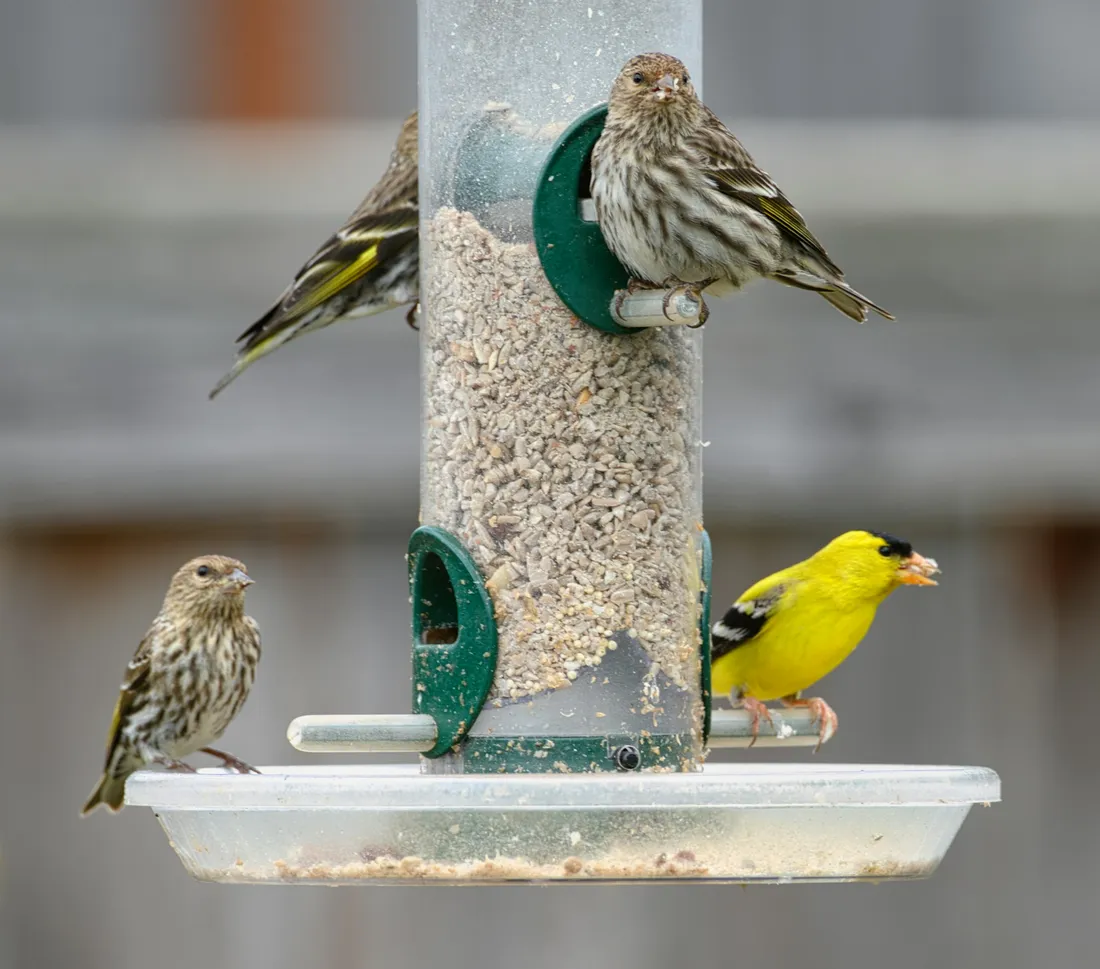
The photo of a goldfinch with Pine Siskins at a tube feeder (below) shows what a mixed winter flock looks like.
Summer-only birds
These birds don’t appear in FeederWatch’s November-to-April counts. For range maps, see each species on All About Birds.
- Ruby-throated Hummingbird: the only breeding hummingbird in eastern North America. It winters from Mexico to Costa Rica or Panama, Audubon says. For a summer nectar feeder, Audubon advises skipping red dye, cleaning the feeder often, and keeping it out of reach of cats and away from windows.
- Baltimore Oriole: the black-and-orange male is “unlike any other eastern bird,” per Audubon. It comes to sugar-water feeders and to fruit put out at feeders. Fall migration starts early, with many leaving in July and August, and it winters mostly in the tropics.
- Rose-breasted Grosbeak: males have a black head, big white wing spots and a “rosy triangle on chest.” Females look like big, heavy-billed sparrows. It winters in the tropics. Audubon’s page doesn’t mention feeders.
Tricky look-alikes
Downy vs Hairy Woodpecker
Both have a white back and a checkered black-and-white pattern. Check three things, all from Audubon:
- Bill: Downy’s is “very short, stubby.” Hairy’s is nearly as long as its head.
- Size: Downy is 5 to 7 inches long. Hairy is 7 to 10 inches, about robin-sized.
- Outer tail feathers: Downy has black bars on them; Hairy’s are clean white.
More woodpecker help is in how to attract woodpeckers.
House Finch vs Purple Finch
- Male color: Audubon says the male Purple Finch is “more of an old-rose color,” washed evenly over the head and foreparts, and lacks obvious dark stripes on the sides. The male House Finch’s red is set against a brown cap, and he has dark streaks on his sides.
- Females: a female Purple Finch has a much stronger face pattern (dark whisker, whitish eyebrow). A female House Finch has a plain brown face.
- Shape: Audubon says the Purple Finch looks chunkier and shorter-tailed.
- Where: in 2024–25 the Purple Finch made the top 25 only in Maine, New Hampshire, Vermont and New York, at 38% to 44% of sites.
Black-capped vs Carolina Chickadee
The Carolina Chickadee is the southern species. A Cornell Lab study in Current Biology (published March 6, 2014) found that the two meet “In a narrow strip that runs across the eastern U.S.” In Pennsylvania, where the study was done, the hybrid zone “is just 21 miles across on average,” and it moved north “at a rate of 0.7 mile per year over the last decade.” It sat where “the average winter low temperature was between 14 and 20 degrees Fahrenheit” (Newswise).
Where the two chickadees meet (schematic, not to scale)
- About 21 miles across on average in the Pennsylvania study area
- Moved north about 0.7 mile a year over the last decade (study published 2014)
- Sat where average winter lows were 14–20°F
Schematic: Carolina Chickadees to the south, Black-capped Chickadees to the north, and a narrow hybrid zone between them that is moving north.
How to tell them apart:
- Range first. Audubon says the Carolina is “Best identified by its more southern range.”
- Wings and bib. The Carolina is a little smaller, with a cleaner, more restricted bib and noticeably less white edging on its wing feathers (Audubon).
- Voice, with a caution. Audubon says the Carolina’s call is higher-pitched and faster, and the Cornell release says its song has four notes instead of two. But Audubon warns that where they overlap, “song may not be helpful for identification as each species can learn the wrong song.”
FeederWatch’s New Jersey and Pennsylvania lists use one combined entry, “Carolina/Black-capped Chickadee.” The other seven Northeast states list Black-capped only.
One more look-alike: Audubon notes that the male House Sparrow, with its black bib, is sometimes misidentified as a chickadee.
Non-native birds at your feeder
Two birds on most Northeast lists were brought here from other continents:
- House Sparrow: native to Eurasia and northern Africa and first released in North America at New York in 1851, Audubon says. Males have a black bib, white cheeks, a gray crown and a chestnut nape. It was at 62% to 79% of sites from Massachusetts south (Rhode Island 79.41%), only 33.05% in New Hampshire, and it didn’t make Maine’s or Vermont’s top 25.
- European Starling: brought to North America in 1890, per Audubon. It’s a short-tailed black bird, heavily spotted with white in fresh fall plumage. Its figure ranged from 36.18% (Vermont) to 69.40% (New Jersey).
Audubon says the House Sparrow has probably affected some native birds by competing for nest sites and food, and that the starling has had a negative impact on some native hole-nesters, such as bluebirds. The US Fish and Wildlife Service says the European starling and house sparrow “don’t belong to families covered by the MBTA” (the Migratory Bird Treaty Act) (USFWS). State and local rules can still apply, so check yours before removing nests.
The low-conflict fix is food choice. Our seed guide explains why keeping millet, cracked corn and peanut hearts out of hanging feeders helps, and why striped sunflower’s thick shell is harder for House Sparrows to crack.
What to put out for Northeast birds
| Food | Northeast birds it brings in | Feeder |
|---|---|---|
| Black-oil sunflower | Chickadees, titmice, nuthatches, cardinals, finches, Blue Jays | Tube, hopper or platform |
| Suet | Downy, Hairy and Red-bellied Woodpeckers, nuthatches, chickadees, Carolina Wren | Suet cage, ideally with a tail prop |
| White proso millet | Juncos, White-throated, Song and American Tree Sparrows, Mourning Doves | Low tray or ground, small amounts |
| Nyjer or hulled sunflower | American Goldfinch, Pine Siskin, redpolls | Finch tube or mesh sock |
| Peanuts (unsalted) | Blue Jay, Tufted Titmouse, woodpeckers, Carolina Wren | Mesh peanut feeder |
Sources: our types of bird seed guide (Geis 1980, Audubon) and the Audubon species pages above. For seasonal detail, see what to feed birds in winter. Woodpecker setups are in best suet feeders for woodpeckers. For placement, see where to put a bird feeder, and if squirrels get there first, how to keep squirrels off a bird feeder.
Starter setup (prices checked October 11, 2026)
- Seed: Duncraft Black Oil Sunflower, 5 lb (opens in a new tab), $18.95, available to order (Duncraft)
- Suet: Birds Choice Tail Prop Suet Feeder (opens in a new tab) (holds one cake), $39.95 at Duncraft, available to order (Duncraft)
- Water: API 14-inch heated bird bath (14B) (opens in a new tab), $135.99 list; unavailable on the maker’s store on October 11, 2026, so check other sellers (Miller Manufacturing)
Bear country: New Hampshire Fish and Game says to “Stop feeding wild birds by April 1,” and, south of the White Mountains, to consider removing feeders by March 15 or at the onset of spring-like weather, whichever comes first (NH Fish and Game). Check your own state wildlife agency’s dates.
Winter water
When ponds and puddles freeze, a bird bath with open water can bring in birds that rarely use seed feeders, like the robins in the snow photo below. A thermostatic heated bath is the simplest fix; our picks are in best heated bird baths. Non-electric options and their limits are in how to keep a bird bath from freezing.
Watching them: binoculars or a camera
From the kitchen window, a Downy and a Hairy look alike; seeing the bill takes magnification. Our beginner binoculars guide explains what to buy. One example: the Celestron Nature DX 8x42 (opens in a new tab) was $179.95 and in stock on celestron.com on October 11, 2026 (Celestron). If you’d rather review visits later, a camera bird feeder records them for you.
Count your birds: Project FeederWatch
The numbers on this page come from volunteers. Project FeederWatch, from the Cornell Lab of Ornithology and Birds Canada, runs from November 1 through April 30. You count the birds at your feeders and enter them on the website or tally them in real time on a phone or tablet (FeederWatch, join page). New participants can opt for a bird ID poster or a calendar. Sign up at feederwatch.org. Your counts help shape next year’s state lists.
Sources
- Project FeederWatch (Cornell Lab of Ornithology and Birds Canada): Top 25, 2024–25, state pages for ME, NH, VT, MA, RI, CT, NY, NJ, PA; Join or renew; Home
- National Audubon Society field guide: species pages linked in each heading above
- Newswise: Warming temperatures are pushing two chickadee species and their hybrids northward (Cornell Lab / Current Biology, March 6, 2014)
- Finch Research Network, Winter Finch Forecast 2026–2027
- US Fish and Wildlife Service, Service publishes final list of non-native bird species (March 15, 2005)
- New Hampshire Fish and Game, bear attractants (March 27, 2025)
- CDC National Center for Health Statistics, Geographic region (US Census Bureau regions and divisions)
- Products: Duncraft black-oil sunflower, Birds Choice Tail Prop Suet Feeder at Duncraft, API 14B heated bath (Miller Manufacturing), Celestron Nature DX 8x42
Frequently asked questions
- What is the most common backyard bird in the Northeast?
- It depends on the state. In Project FeederWatch's 2024–25 counts, the Black-capped Chickadee ranked first in Maine, New Hampshire, Vermont and Massachusetts, and tied for first with the Downy Woodpecker in Rhode Island. The Dark-eyed Junco ranked first in Connecticut and New York, and the Northern Cardinal in New Jersey and Pennsylvania.
- What birds stay in the Northeast all winter?
- Audubon describes chickadees, Tufted Titmice, White-breasted Nuthatches, Downy, Hairy and Red-bellied Woodpeckers, Northern Cardinals and Carolina Wrens as permanent or mostly permanent residents. Blue Jays, Mourning Doves, goldfinches and robins are partial migrants: some stay through winter and some move south.
- When do juncos come to Northeast feeders?
- Juncos are a winter bird at most Northeast feeders. Audubon says most populations migrate and that winter flocks gather at woodland edges and in suburban yards. In FeederWatch's November-to-April counts for 2024–25, the junco's figure was between 85.76% and 93.49% of sites in every Northeast state.
- How do I tell a Black-capped from a Carolina Chickadee?
- Start with where you live: the Carolina is the southern species, and the two meet in a narrow strip across the eastern US. Audubon says the Carolina has less white edging on its wing feathers, a cleaner, more restricted bib and a higher, faster call. Song can mislead where they overlap, because each species can learn the other's song.
- What should I feed birds in the Northeast in winter?
- Black-oil sunflower in a tube or hopper, suet for woodpeckers and nuthatches, and white proso millet on a low tray for juncos and sparrows. Add a heated bird bath for open water.
- Why don't I see hummingbirds in winter?
- The Ruby-throated Hummingbird, the only breeding hummingbird in eastern North America, leaves for the winter. Audubon says it winters from Mexico to Costa Rica or Panama.
Keep reading

Written by
Research and editing
The Feeder Field editorial team researches backyard birding gear and bird feeding for US readers. We compare manufacturer specifications, subscription terms and long-term owner feedback, and we check feeding and bird-behavior advice against the Cornell Lab of Ornithology, Audubon and university extension services. Articles are drafted with the help of AI tools, then fact-checked and edited by our team before they go live. Every guide says whether it is researched or hands-on tested, and we update buying guides at least every six months.